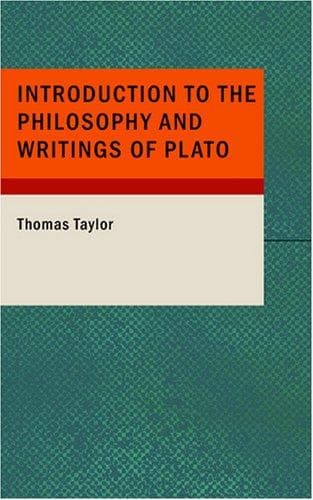
Introduction to the Philosophy and Writings of PlatoTaylor, Thomas
Philosophy
Introduction to the Philosophy and Writings of Plato
Taylor, Thomas
Philosophy; Plato
involving the human intellect in Cimmerian darkness. In our own country,
however, though no one appears to have wholly devoted himself to the
study of this philosophy, and he who does not will never penetrate its
depths, yet we have a few bright examples of no common proficiency in its
more accessible parts.
-----------------
[15] I never yet knew a man who made experiment the test of truth, and I
have known many such, that was not atheistically inclined.
[16] I have ranked Archimedes among the Platonists, because he cultivated
the mathematical sciences Platonically, as is evident from the testimony of
Plutarch in his Life of Marcellus, p. 307. For he there informs us that
Archimedes considered the being busied about mechanics, and in short, every
art which is connected with the common purposes of life, as ignoble and
illiberal; and that those things alone were objects of his ambition with
which the beautiful and the excellent were present, unmingled with the
necessary. The great accuracy and elegance in the demonstrations of Euclid
and Archimedes, which have not been equaled by any of our greatest modern
mathematicians, were derived from a deep conviction of this important
truth. On the other hand modern mathematicians, through a profound
ignorance of this divine truth, and looking to nothing but the wants and
conveniences of the animal life of man, as if the gratification of his
senses was his only end, have corrupted pure geometry, by mingling with it
algebraical calculations, and through eagerness to reduce it as much as
possible to practical purposes, have more anxiously sought after
conciseness than accuracy, facility than elegance of geometrical
demonstration.
-----------------
The instances I allude to are Shaftesbury, Akenside, Harris, Petwin, and
Sydenham. So splendid is the specimen of philosophic abilities displayed by
these writers, like the fair dawning of same unclouded morning, that we
have only deeply to regret that the sun of their genius sat before we were
gladdened with its effulgence. Had it shone with its full strength, the
writer of this Introduction would not have attempted either to translate
the works, or elucidate the doctrines of Plato; but though it rose with
vigor, it dispersed not the clouds in which its light was gradually
involved, and the eye in vain anxiously waited for it's meridian beam.
In short, the principles of the philosophy of Plato are of all others the
most friendly to true piety, pure morality, solid learning, and sound
government. For as it is scientific in all its parts, and in these parts
comprehends all that can be known by man in theology and ethics, and all
that is necessary for him to know in physics, it must consequently contain
in itself the source of all that is great and good both to individuals and
communities, must necessarily exalt while it benefits, and deify while it
exalts.
Public-domain text, read in full here on John Shaqi.
Reviews
Reviews
No reviews yet
Be the first to share your thoughts on this work.
Elsewhere in the archive
Join the Discussion
Join the discussion
Sign in to leave a comment or review.
Sign InorCreate an account