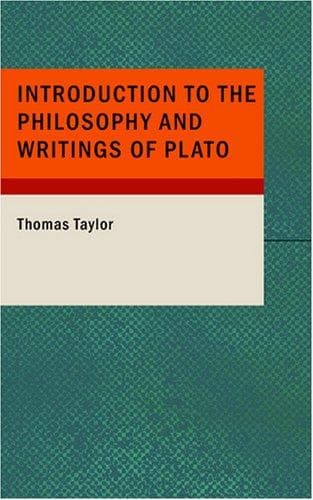
Introduction to the Philosophy and Writings of PlatoTaylor, Thomas
Philosophy
Introduction to the Philosophy and Writings of Plato
Taylor, Thomas
Philosophy; Plato
And here gratitude demands that I should publicly acknowledge the very
handsome and liberal manner in which I was received by the University of
Oxford, and by the principal librarian and sub-librarians of the Bodleian
library, during the time that I made the above mentioned extracts. In the
first place I have to acknowledge the very polite attention which was paid
to me by Dr. Jackson,[31] dean of Christ-church. In the second place, the
liberty of attendance at the Bodleian library, and the accommodation which
was there afforded me, by the librarians of that excellent collection,
demand from me no small tribute of praise. And, above all, the very liberal
manner in which I was received by the fellows of New College, with whom I
resided for three weeks, and from whom I experienced even Grecian
hospitality, will, I trust, be as difficult a task for time to obliterate
from my memory, as it would be for me to express it as it deserves.
-----------------
[31] I was much pleased to find that this very respectable prelate is a
great admirer of Aristotle, and that extracts from the Commentaries of
Simplicius and Ammonius on the Categories of that philosopher, are read
by his orders in the college of which he is the head.
-----------------
With respect to the faults which I may have committed in this translation
(for I am not vain enough to suppose it is without fault), I might plead
as an excuse, that the whole of it has been executed amidst severe
endurance from bodily infirmity and indigent circumstances; and that a
very considerable part of it was accomplished amidst other ills of no
common magnitude, and other labors inimical to such an undertaking. But
whatever may be my errors, I will not fly to calamity for an apology. Let
it be my excuse that the mistakes I may have committed in lesser
particulars, have arisen from my eagerness to seize and promulgate those
great truths in the philosophy and theology of Plato, which though they
have been concealed for ages in oblivion, have a subsistence coeval with
the universe, and will again be restored, and flourish for very extended
periods, through all the infinite revolutions of time.
In the next place, it is necessary to speak concerning the qualifications
requisite in a legitimate student of the philosophy of Plato, previous to
which I shall just notice the absurdity of supposing that a mere knowledge
of the Greek tongue, however great that knowledge may be, is alone
sufficient to the understanding the sublime doctrines of Plato; for a man
might as well think that he can understand Archimedes without a knowledge
of the elements of geometry, merely because he can read him in the
original. Those who entertain such an idle opinion, would do well to
meditate on the profound observation of Heraclitus, "that polymathy does
not teach intellect," ([Greek: Polymathic noon ou didaskei]).
Public-domain text, read in full here on John Shaqi.
Reviews
Reviews
No reviews yet
Be the first to share your thoughts on this work.
Elsewhere in the archive
Join the Discussion
Join the discussion
Sign in to leave a comment or review.
Sign InorCreate an account