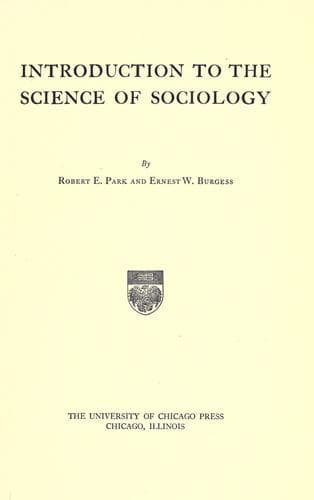
Introduction to the Science of SociologyPark, Robert Ezra
General
Introduction to the Science of Sociology
Park, Robert Ezra
Sociology
I will take another example, this time from the literature of ancient
Greece. In one of the shortest but not least impressive of his
_Dialogues_, the "Crito," Plato tells us of the character of Socrates,
not as a philosopher, but as a good citizen. He has been unjustly
condemned by the Athenians as an enemy to the good of the state. Crito
comes to him in prison to persuade him to escape. He urges on him many
arguments, his duty to his children included. But Socrates refuses. He
chooses to follow, not what anyone in the crowd might do, but the
example which the ideal citizen should set. It would be a breach of his
duty to fly from the judgment duly passed in the Athens to which he
belongs, even though he thinks the decree should have been different.
For it is the decree of the established justice of his city state. He
will not "play truant." He hears the words, "Listen, Socrates, to us who
have brought you up"; and in reply he refuses to go away, in these
final sentences: "This is the voice which I seem to hear murmuring in my
ears, like the sound of the flute in the ears of the mystic; that voice,
I say, is murmuring in my ears, and prevents me from hearing any other.
And I know that anything more which you may say will be vain."
Why do men of this stamp act so, it may be when leading the battle line,
it may be at critical moments of quite other kinds? It is, I think,
because they are more than mere individuals. Individual they are, but
completely real, even as individual, only in their relation to organic
and social wholes in which they are members, such as the family, the
city, the state. There is in every truly organized community a Common
Will which is willed by those who compose that community, and who in so
willing are more than isolated men and women. It is not, indeed, as
unrelated atoms that they have lived. They have grown, from the
receptive days of childhood up to maturity, in an atmosphere of example
and general custom, and their lives have widened out from one little
world to other and higher worlds, so that, through occupying successive
stations in life, they more and more come to make their own the life of
the social whole in which they move and have their being. They cannot
mark off or define their own individualities without reference to the
individualities of others. And so they unconsciously find themselves as
in truth pulse-beats of the whole system, and themselves the whole
system. It is real in them and they in it. They are real only because
they are social. The notion that the individual is the highest form of
reality, and that the relationship of individuals is one of mere
contract, the notion of Hobbes and of Bentham and of Austin, turns out
to be quite inadequate. Even of an everyday contract, that of marriage,
it has been well said that it is a contract to pass out of the sphere of
contract, and that it is possible only because the contracting parties
are already beyond and above that sphere. As a modern writer, F.
Public-domain text, read in full here on John Shaqi.
Reviews
Reviews
No reviews yet
Be the first to share your thoughts on this work.
Elsewhere in the archive
Join the Discussion
Join the discussion
Sign in to leave a comment or review.
Sign InorCreate an account