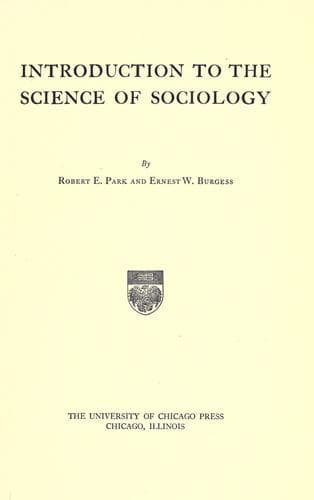
Introduction to the Science of SociologyPark, Robert Ezra
General
Introduction to the Science of Sociology
Park, Robert Ezra
Sociology
For him, as for those
who have had a yet clearer grasp of the principle, in willing the
General Will we not only realize our true selves but we may rise above
our ordinary habit of mind. We may reach heights which we could not
reach, or which at all events most of us could not reach, in isolation.
There are few observers who have not been impressed with the wonderful
unity and concentration of purpose which an entire nation may
display--above all, in a period of crisis. We see it in time of war,
when a nation is fighting for its life or for a great cause. We have
marvelled at the illustrations with which history abounds of the General
Will rising to heights of which but few of the individual citizens in
whom it is embodied have ever before been conscious even in their
dreams.
By leadership a common ideal can be made to penetrate the soul of a
people and to take complete possession of it. The ideal may be very
high, or it may be of so ordinary a kind that we are not conscious of it
without the effort of reflection. But when it is there it influences and
guides daily conduct. Such idealism passes beyond the sphere of law,
which provides only what is necessary for mutual protection and liberty
of just action. It falls short, on the other hand, in quality of the
dictates of what Kant called the Categorical Imperative that rules the
private and individual conscience, but that alone, an Imperative which
therefore gives insufficient guidance for ordinary and daily social
life. Yet the ideal of which I speak is not the less binding; and it is
recognized as so binding that the conduct of all good men conforms to
it.
C. PERSONALITY AND THE SOCIAL SELF
1. The Organism as Personality[69]
The organism and the brain, as its highest representation, constitute
the real personality, containing in itself all that we have been, and
the possibility of all that we shall be. The complete individual
character is inscribed there with all its active and passive aptitudes,
sympathies, and antipathies; its genius, talents, or stupidity; its
virtues, vices, torpor, or activity. Of all these, what emerges and
actually reaches consciousness is only a small item compared with what
remains buried below, albeit still active. Conscious personality is
always but a feeble portion of physical personality.
The unity of the ego, consequently, is not that of the one-entity of
spiritualists which is dispersed into multiple phenomena, but the
co-ordination of a certain number of incessantly renascent states,
having for their support the vague sense of our bodies. This unity does
not pass from above to below, but from below to above; the unity of the
ego is not an initial, but a terminal point.
Public-domain text, read in full here on John Shaqi.
Reviews
Reviews
No reviews yet
Be the first to share your thoughts on this work.
Elsewhere in the archive
Join the Discussion
Join the discussion
Sign in to leave a comment or review.
Sign InorCreate an account