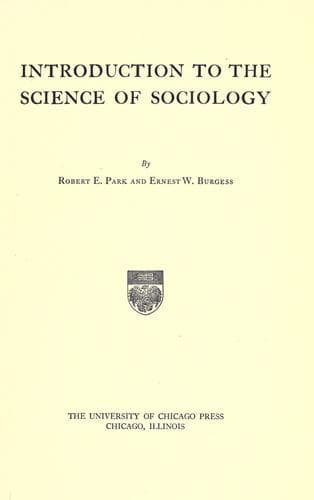
Introduction to the Science of SociologyPark, Robert Ezra
General
Introduction to the Science of Sociology
Park, Robert Ezra
Sociology
The great mass of our ideas involve associations of the origin of which
we are unaware because the memories of the original experience have
become split and a large portion thus has become forgotten even if ever
fully appreciated. We all have our prejudices, our likes and dislikes,
our tastes and aversions; it would tax our ingenuity to give a
sufficient psychological account of their origin. They were born long
ago in educational, social, personal, and other experiences, the details
of which we have this many a year forgotten. It is the residua of these
experiences that have persisted and become associated into complexes
which are retained as traits of our personality.
3. The Self as the Individual's Conception of His Rôle[71]
Suggestion may have its end and aim in the creation of a new
personality. The experimenter then chooses the sort of personality he
wishes to induce and obliges the subject to realize it. Experiments of
this kind succeeding in a great many somnambulists, and usually
producing very curious results, have long been known and have been
repeated, one might say, almost to satiety within the last few years.
When we are awake and in full possession of all our faculties we can
imagine sensations different from those which we ordinarily experience.
For example, when I am sitting quietly at my table engaged in writing
this book, I can conceive the sensations that a soldier, a woman, an
artist, or an Englishman would experience in such and such a situation.
But, however fantastic the conceptions may be that we form, we do not
cease to be conscious withal of our own personal existence. Imagination
has taken flight fairly in space, but the memory of ourselves always
remains behind. Each of us knows that he is himself and not another,
that he did this yesterday, that he has just written a letter, that he
must write another such letter tomorrow, that he was out of Paris for a
week, etc. It is this memory of passed facts--a memory always present to
the mind--that constitutes the consciousness of our normal personality.
It is entirely different in the case of the two women, A---- and B----,
that M. Richet studied.
Put to sleep and subjected to certain influences, A---- and
B---- forget their identity; their age, their clothing, their
sex, their social position, their nationality, the place and
the time of their life--all this has entirely disappeared.
Only a single idea remains--a single consciousness--it is the
consciousness of the idea and of the new being that dawns upon
their imagination.
They have lost the idea of their late existence. They live,
talk, and think exactly like the type that is suggested to
them. With what tremendous intensity of life these types are
realized, only those who have been present at these experiments
can know. Description can only give a weak and imperfect idea
of it.
Public-domain text, read in full here on John Shaqi.
Reviews
Reviews
No reviews yet
Be the first to share your thoughts on this work.
Elsewhere in the archive
Join the Discussion
Join the discussion
Sign in to leave a comment or review.
Sign InorCreate an account