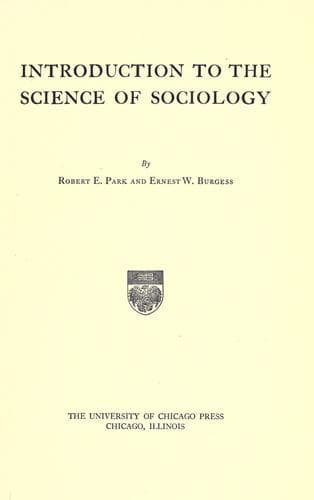
Introduction to the Science of SociologyPark, Robert Ezra
General
Introduction to the Science of Sociology
Park, Robert Ezra
Sociology
In a more recent paper, prepared with the co-operation of M. Ferrari and
M. Hericourt, M. Richet has added a curious detail to the preceding
experiments. He has shown that the subject on whom a change of
personality is imposed not only adapts his speech, gestures, and
attitudes to the new personality, but that even his handwriting is
modified and brought into relation with the new ideas that absorb his
consciousness. This modification of handwriting is an especially
interesting discovery, since handwriting, according to current theories,
is nothing more than a sort of imitation. I cite some examples borrowed
from these authors.
It is suggested in succession to a young student that he is a sly and
crafty peasant, then a miser, and finally a very old man. While the
subject's features and behavior generally are modified and brought into
harmony with the idea of the personality suggested, we may observe also
that his handwriting undergoes similar modifications which are not less
marked. It has a special character peculiar to each of the new states of
personality. In short, the graphic movements change like the gestures
generally.
In a note on the handwriting of hysterical patients, I have shown that
under the influence of suggested emotions, or under the influence of
sensorial stimulations, the handwriting of a hysterical patient may be
modified. It gets larger, for example, in cases of dynamogenic
excitation.
The characteristic of the suggestion that we have just studied is that
it does not bear exclusively on perception or movement--that is to say,
on a limited psychic element; but there are comprehensive suggestions.
They impose a topic on the subject that he is obliged to develop with
all the resources of his intellect and imagination, and if the
observations be carefully examined, it will also be seen that in these
suggestions the faculties of perception are affected and perverted by
the same standard as that of ideation. Thus the subject, under the
influence of his assumed personality, ceases to perceive the external
world as it exists. He has hallucinations in connection with his new
psychological personality. When a bishop, he thinks he is in Notre Dame,
and sees a host of the faithful. When a general, he thinks he is
surrounded by troops, etc. Things that harmonize with the suggestion are
conjured up. This systematic development of states of consciousness
belongs to all kinds of suggestions, but is perhaps nowhere else so
marked as in these transformations of personality.
Public-domain text, read in full here on John Shaqi.
Reviews
Reviews
No reviews yet
Be the first to share your thoughts on this work.
Elsewhere in the archive
Join the Discussion
Join the discussion
Sign in to leave a comment or review.
Sign InorCreate an account