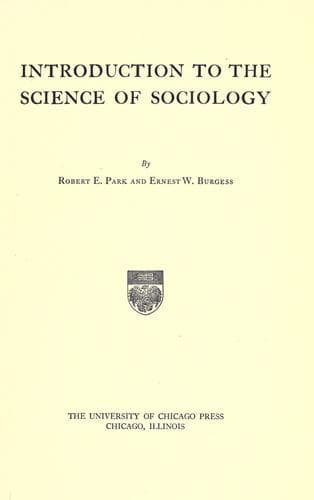
Introduction to the Science of SociologyPark, Robert Ezra
General
Introduction to the Science of Sociology
Park, Robert Ezra
Sociology
5. The Divided Self and Moral Consciousness[73]
Two ways of looking at life are characteristic respectively of what we
call the healthy-minded, who need to be born only once, and of the sick
souls, who must be twice-born in order to be happy. The result is two
different conceptions of the universe of our experience. In the religion
of the once-born the world is a sort of rectilineal or one-storied
affair, whose accounts are kept in one denomination, whose parts have
just the values which naturally they appear to have, and of which a
simple algebraic sum of pluses and minuses will give the total worth.
Happiness and religious peace consist in living on the plus side of the
account. In the religion of the twice-born, on the other hand, the world
is a double-storied mystery. Peace cannot be reached by the simple
addition of pluses and elimination of minuses from life. Natural good is
not simply insufficient in amount and transient; there lurks a falsity
in its very being. Cancelled as it all is by death, if not by earlier
enemies, it gives no final balance, and can never be the thing intended
for our lasting worship. It keeps us from our real good, rather; and
renunciation and despair of it are our first step in the direction of
the truth. There are two lives, the natural and the spiritual, and we
must lose the one before we can participate in the other.
In their extreme forms, of pure naturalism and pure salvationism, the
two types are violently contrasted; though here, as in most other
current classifications, the radical extremes are somewhat ideal
abstractions, and the concrete human beings whom we oftenest meet are
intermediate varieties and mixtures. Practically, however, you all
recognize the difference: you understand, for example, the disdain of
the Methodist convert for the mere sky-blue healthy-minded moralist; and
you likewise enter into the aversion of the latter to what seems to him
the diseased subjectivism of the Methodist, dying to live, as he calls
it, and making of paradox and the inversion of natural appearances the
essence of God's truth.
The psychological basis of the twice-born character seems to be a
certain discordancy or heterogeneity in the native temperament of the
subject, an incompletely unified moral and intellectual constitution.
"Homo duplex, homo duplex!" writes Alphonse Daudet. "The first time that
I perceived that I was two was at the death of my brother Henri, when my
father cried out so dramatically, 'He is dead, he is dead!' While my
first self wept, my second self thought, 'How truly given was that cry,
how fine it would be at the theater.' I was then fourteen years old.
This horrible duality has often given me matter for reflection. Oh, this
terrible second me, always seated whilst the other is on foot, acting,
living, suffering, bestirring itself. This second me that I have never
been able to intoxicate, to make shed tears, or put to sleep. And how it
sees into things, and how it mocks!"
Public-domain text, read in full here on John Shaqi.
Reviews
Reviews
No reviews yet
Be the first to share your thoughts on this work.
Elsewhere in the archive
Join the Discussion
Join the discussion
Sign in to leave a comment or review.
Sign InorCreate an account