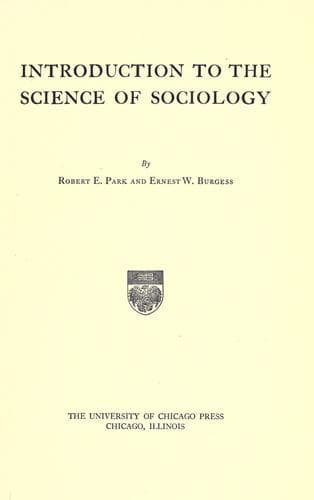
Introduction to the Science of SociologyPark, Robert Ezra
General
Introduction to the Science of Sociology
Park, Robert Ezra
Sociology
Tradition is, in a sense and if such a comparison were profitable, more
conservative than heredity. There is in the content of tradition an
invariability which could not exist if it were a dual composite, as is
the constitution of the germ-plasm. Here we must recall certain
essential qualities of the mores which we have hitherto viewed from
another angle. Tradition always looks to the folkways as constituting
the matter to be transmitted. But the folkways, after the concurrence
in their practice has been established, come to include a judgment that
they conduce to societal and, indeed, individual welfare. This is where
they come to be properly called mores. They become the prosperity-policy
of the group, and the young are reared up under their sway, looking to
the older as the repositories of precedent and convention. But presently
the older die, and in conformity with the ideas of the time, they become
beings of a higher power toward whom the living owe duty, and whose will
they do not wish to cross. The sanction of ghost-fear is thus extended
to the mores, which, as the prosperity-policy of the group, have already
taken on a stereotyped character. They thus become in an even higher
degree "uniform, universal in a group, imperative, invariable. As time
goes on, they become more and more arbitrary, positive, and imperative.
If asked why they act in a certain way in certain cases, primitive
people always answer that it is because they and their ancestors always
have done so." Thus the transmission of the mores comes to be a process
embodying the greatest conservatism and the least likelihood of change.
This situation represents an adaption of society to life-conditions; it
would seem that because of the rapidity of succession of variations
there is need of an intensely conserving force (like ethnocentrism or
religion) to preserve a certain balance and poise in the evolutionary
movement.
Transmission of the mores takes place through the agency of imitation or
of inculcation; through one or the other according as the initiative is
taken by the receiving or the giving party respectively. Inculcation
includes education in its broadest sense; but since that term implies in
general usage a certain, let us say protective, attitude taken by the
educator (as toward the young), the broader and more colorless
designation is chosen. Acculturation is the process by which one group
or people learns from another, whether the culture or civilization be
gotten by imitation or by inculcation. As there must be contact,
acculturation is sometimes ascribed to "contagion."
4. Temperament, Tradition, and Nationality[78]
Public-domain text, read in full here on John Shaqi.
Reviews
Reviews
No reviews yet
Be the first to share your thoughts on this work.
Elsewhere in the archive
Join the Discussion
Join the discussion
Sign in to leave a comment or review.
Sign InorCreate an account