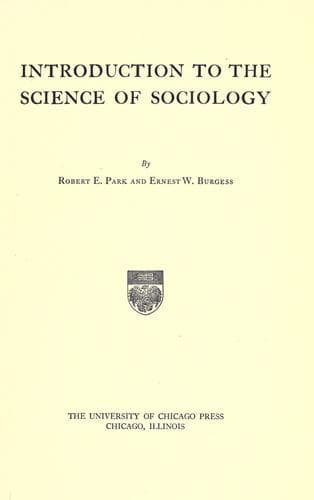
Introduction to the Science of SociologyPark, Robert Ezra
General
Introduction to the Science of Sociology
Park, Robert Ezra
Sociology
If it is true that the Jew just because of his intellectuality is a
natural-born idealist, internationalist, doctrinaire, and revolutionist,
while the Negro, because of his natural attachment to known familiar
objects, places, and persons, is pre-adapted to conservatism and to
local and personal loyalties--if these things are true, we shall
eventually have to take account of them practically. It is certain that
the Negro has uniformly shown a disposition to loyalty during slavery to
his master and during freedom to the South and the country as a whole.
He has maintained this attitude of loyalty, too, under very discouraging
circumstances. I once heard Kelly Miller, the most philosophical of the
leaders and teachers of his race, say in a public speech that one of the
greatest hardships the Negro suffered in this country was due to the
fact that he was not permitted to be patriotic.
Of course all these alleged racial characteristics have a positive as
well as a negative significance. Every race, like every individual, has
the vices of its virtues. The question remains still to what extent
so-called racial characteristics are actually racial, i.e., biological,
and to what extent they are the effect of environmental conditions. The
thesis of this paper, to state it again, is: (1) that fundamental
temperamental qualities, which are the basis of interest and attention,
act as selective agencies and as such determine what elements in the
cultural environment each race will select; in what region it will seek
and find its vocation in the larger social organization; (2) that, on
the other hand, technique, science, machinery, tools, habits,
discipline, and all the intellectual and mechanical devices with which
the civilized man lives and works remain relatively external to the
inner core of significant attitudes and values which constitute what we
may call the will of the group. This racial will is, to be sure, largely
social, that is, modified by social experience, but it rests ultimately
upon a complex of inherited characteristics, which are racial.
Public-domain text, read in full here on John Shaqi.
Reviews
Reviews
No reviews yet
Be the first to share your thoughts on this work.
Elsewhere in the archive
Join the Discussion
Join the discussion
Sign in to leave a comment or review.
Sign InorCreate an account