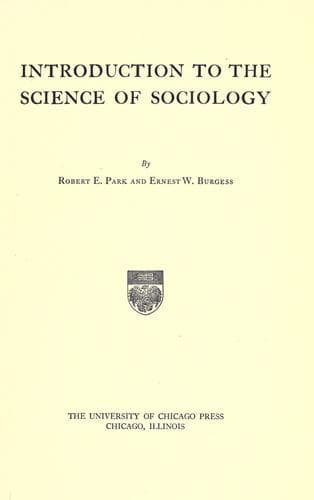
Introduction to the Science of SociologyPark, Robert Ezra
General
Introduction to the Science of Sociology
Park, Robert Ezra
Sociology
When the physical unity of a group is perpetuated by the succession of
parents and children, the racial temperament, including fundamental
attitudes and values which rest in it, is preserved intact. When,
however, society grows and is perpetuated by immigration and adaptation,
there ensues, as a result of miscegenation, a breaking up of the complex
of the biologically inherited qualities which constitute the temperament
of the race. This again initiates changes in the mores, traditions, and
eventually in the institutions of the community. The changes which
proceed from modification in the racial temperament will, however,
modify but slightly the external forms of the social traditions, but
they will be likely to change profoundly their content and meaning. Of
course other factors, individual competition, the formation of classes,
and especially the increase of communication, all co-operate to
complicate the whole situation and to modify the effects which would be
produced by racial factors working in isolation.
III. INVESTIGATIONS AND PROBLEMS
1. Conceptions of Human Nature Implicit in Religious and Political
Doctrines
Although the systematic study of it is recent, there has always been a
certain amount of observation and a great deal of assumption in regard
to human nature. The earliest systematic treatises in jurisprudence,
history, theology, and politics necessarily proceeded from certain more
or less naïve assumptions in regard to the nature of man. In the
extension of Roman law over subject peoples the distinction was made
between _jus gentium_ and _jus naturae_, i.e., the laws peculiar to a
particular nation as contrasted with customs and laws common to all
nations and derived from the nature of mankind. Macauley writes of the
"principles of human nature" from which it is possible to deduce a
theory of government. Theologians, in devising a logical system of
thought concerning the ways of God to man, proceeded on the basis of
certain notions of human nature. The doctrines of original sin, the
innate depravity of man, the war of the natural man and the spiritual
man had a setting in the dogmas of the fall of man, redemption through
faith, and the probationary character of life on earth. In striking
contrast with the pessimistic attitude of theologians toward human
nature, social revolutionists like Rousseau have condemned social
institutions as inherently vicious and optimistically placed reliance
upon human nature as innately good.
In all these treatises the assumptions about human nature are either
preconceptions or rationalizations from experience incidental to the
legal, moral, religious, or political system of thought. There is in
these treatises consequently little or no analysis or detailed
description of the traits attributed to men. Certainly, there is no
evidence of an effort to arrive at an understanding of human behavior
from an objective study of its nature.
Public-domain text, read in full here on John Shaqi.
Reviews
Reviews
No reviews yet
Be the first to share your thoughts on this work.
Elsewhere in the archive
Join the Discussion
Join the discussion
Sign in to leave a comment or review.
Sign InorCreate an account