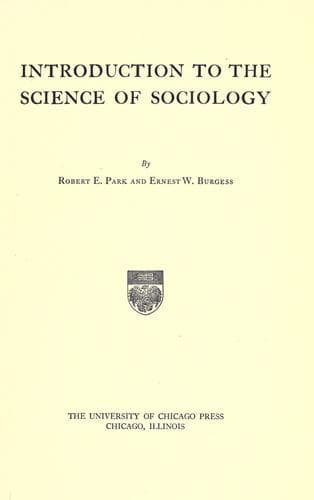
Introduction to the Science of SociologyPark, Robert Ezra
General
Introduction to the Science of Sociology
Park, Robert Ezra
Sociology
The social organization of human beings, on the other hand, the various
types of social groups, and the changes which take place in them at
different times under varying circumstances, are determined not merely
by instincts and by competition but by custom, tradition, public
opinion, and contract. In animal societies as herds, flocks, and packs,
collective behavior seems obviously to be explained in terms of instinct
and emotion. In the case of man, however, instincts are changed into
habits; emotions, into sentiments. Furthermore, all these forms of
behavior tend to become conventionalized and thus become relatively
independent of individuals and of instincts. The behavior of the person
is thus eventually controlled by the formal standards which, implicit in
the mores, are explicit in the laws. Society now may be defined as the
social heritage of _habit and sentiment_, _folkways and mores_,
_technique and culture_, all of which are incident or necessary to
collective human behavior.
Human society, then, unlike animal society is mainly a social heritage,
created in and transmitted by communication. The continuity and life of
a society depend upon its success in transmitting from one generation to
the next its folkways, mores, technique, and ideals. From the standpoint
of collective behavior these cultural traits may all be reduced to the
one term "consensus." Society viewed abstractly is an organization of
individuals; considered concretely it is a complex of organized habits,
sentiments, and social attitudes--in short, consensus.
The terms society, community, and social group are now used by students
with a certain difference of emphasis but with very little difference in
meaning. Society is the more abstract and inclusive term, and society is
made up of social groups, each possessing its own specific type of
organization but having at the same time all the general characteristics
of society in the abstract. Community is the term which is applied to
societies and social groups where they are considered from the point of
view of the geographical distribution of the individuals and
institutions of which they are composed. It follows that every community
is a society, but not every society is a community. An individual may
belong to many social groups but he will not ordinarily belong to more
than one community, except in so far as a smaller community of which he
is a member is included in a larger of which he is also a member.
However, an individual is not, at least from a sociological point of
view, a member of a community because he lives in it but rather because,
and to the extent that, he participates in the common life of the
community.
Public-domain text, read in full here on John Shaqi.
Reviews
Reviews
No reviews yet
Be the first to share your thoughts on this work.
Elsewhere in the archive
Join the Discussion
Join the discussion
Sign in to leave a comment or review.
Sign InorCreate an account