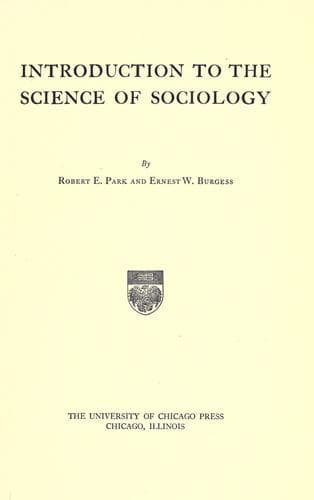
Introduction to the Science of SociologyPark, Robert Ezra
General
Introduction to the Science of Sociology
Park, Robert Ezra
Sociology
To society the most alien relations of two living beings which can be
produced are those of the predator and his prey. In general, the
predator is bulkier than his prey, since he overcomes him and devours
him. Yet smaller ones sometimes attack larger creatures, consuming them,
however, by instalments, and letting them live that they themselves may
live on them as long as possible. In such a case they are forced to
remain for a longer or a shorter time attached to the body of their
victim, carried about by it wherever the vicissitudes of its life lead
them. Such animals have received the name of parasites. Parasitism forms
the line inside of which our subject begins; for if one can imagine that
the parasite, instead of feeding on the animal from whom he draws his
subsistence, is content to live on the remains of the other's meals, one
will find himself in the presence, not yet of an actual society, but of
half the conditions of a society; that is to say, a relation between two
beings such that, all antagonism ceasing, one of the two is useful to
the other. Such is commensalism. However, this association does not yet
offer the essential element of all society, co-operation. There is
co-operation when the commensal is not less useful to his host than the
latter is to the commensal himself, when the two are concerned in living
in a reciprocal relation and in developing their double activity in
corresponding ways toward a single and an identical goal. One has given
to this mode of activity the name of mutualism. Domestication is only
one form of it. Parasitism, commensalism, mutualism, exist with animals
among the different species.
2. Symbiosis (literally "living together")[82]
In gaining their wide and intimate acquaintance with the vegetable world
the ants have also become acquainted with a large number of insects that
obtain their nutriment directly from plants, either by sucking up their
juices or by feeding on their foliage. To the former group belong the
phytophthorous Homoptera, the plant lice, scale insects, or mealy bugs,
tree-hoppers, lantern flies, and jumping plant lice; to the latter
belong the caterpillars of the lycaenid butterflies, the "blues," or
"azures," as they are popularly called. All of these creatures excrete
liquids which are eagerly sought by the ants and constitute the whole,
or, at any rate, an important part of the food of certain species. In
return the Homoptera and caterpillars receive certain services from the
ants, so that the relations thus established between these widely
different insects may be regarded as a kind of symbiosis. These
relations are most apparent in the case of the aphids, and these insects
have been more often and more closely studied in Europe and America.
Public-domain text, read in full here on John Shaqi.
Reviews
Reviews
No reviews yet
Be the first to share your thoughts on this work.
Elsewhere in the archive
Join the Discussion
Join the discussion
Sign in to leave a comment or review.
Sign InorCreate an account