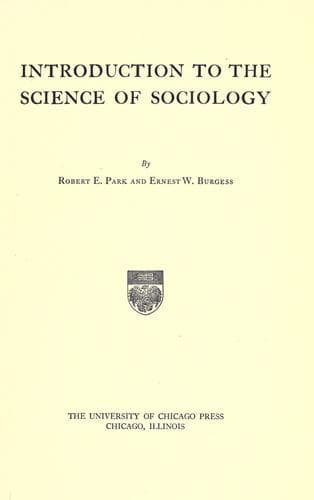
Introduction to the Science of SociologyPark, Robert Ezra
General
Introduction to the Science of Sociology
Park, Robert Ezra
Sociology
5. This is also exhibited by all ants that harbor root-aphids and
root-coccids in their nests. Not only are these insects kept in
confinement by the ants, but they are placed by them on the roots. In
order to do this the ants remove the earth from the surfaces of the
roots and construct galleries and chambers around them so that the
Homoptera may have easy access to their food and even move about at
will.
6. Many ants construct, often at some distance from their nests, little
closed pavilions or sheds of earth, carton, or silk, as a protection for
their cattle and for themselves. The singular habit may be merely a more
recent development from the older and more general habit of excavating
tunnels and chambers about roots and subterranean stems.
7. The solicitude of the ants not only envelops the adult aphids and
coccids, but extends also to their eggs and young. Numerous observers
have observed ants in the autumn collecting and storing aphid eggs in
the chambers of their nests, caring for them through the winter and in
the spring placing the recently hatched plant lice on the stems and
roots of the plants.
In the foregoing I have discussed the ethological relations of ants to a
variety of other organisms. This, however, did not include an account of
some of the most interesting symbiotic relations, namely, those of the
ants to other species of their own taxonomic group and to termites. This
living together of colonies of different species may be properly
designated as social symbiosis, to distinguish it from the simple
symbiosis that obtains between individual organisms of different species
and the intermediate form of symbiosis exhibited by individual organisms
that live in ant or termite colonies.
The researches of the past forty years have brought to light a
remarkable array of instances of social symbiosis, varying so much in
intimacy and complexity that it is possible to construct a series
ranging from mere simultaneous occupancy of a very narrow ethological
station, or mere contiguity of domicile, to an actual fusion, involving
the vital dependence or parasitism of a colony of one species on that of
another. Such a series is, of course, purely conceptual and does not
represent the actual course of development in nature, where, as in the
animal and vegetable kingdoms in general, development has not followed a
simple linear course, but has branched out repeatedly and terminated in
the varied types at the present time.
Public-domain text, read in full here on John Shaqi.
Reviews
Reviews
No reviews yet
Be the first to share your thoughts on this work.
Elsewhere in the archive
Join the Discussion
Join the discussion
Sign in to leave a comment or review.
Sign InorCreate an account