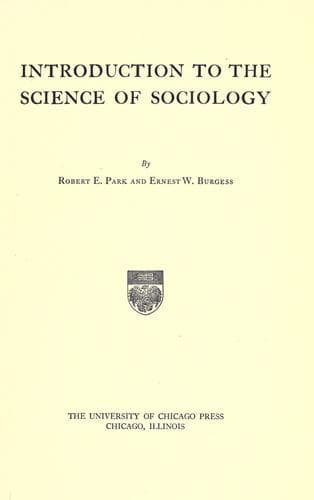
Introduction to the Science of SociologyPark, Robert Ezra
General
Introduction to the Science of Sociology
Park, Robert Ezra
Sociology
When wild animals become tame, they are really extending or transferring
to human beings the confidence and affection they naturally give their
mothers, and this view will be found to explain more facts about
tameness than any other. Every creature that would naturally enjoy
maternal, or it would be better to say parental, care, as the father
sometimes shares in or takes upon himself the duty of guarding the
young, is ready to transfer its devotion to other animals or to human
beings, if the way be made easy for it, and if it be treated without too
great violation of its natural instincts. The capacity to be tamed is
greatest in those animals that remain longest with their parents and
that are most intimately associated with them. The capacity to learn new
habits is greatest in those animals which naturally learn most from
their parents, and in which the period of youth is not merely a period
of growing, a period of the awakening of instincts, but a time in which
a real education takes place. These capacities of being tamed and of
learning new habits are greater in the higher mammals than in the lower
mammals, in mammals than in birds, and in birds than in reptiles. They
are very much greater in very young animals, where dependence on the
parents is greatest, than in older animals, and they gradually fade away
as the animal grows up, and are least of all in fully grown and
independent creatures of high intelligence.
Young animals born in captivity are no more easy to tame than those
which have been taken from the mother in her native haunts. If they
remain with the mother, they very often grow up even shyer and more
intolerant of man than the mothers themselves. There is no inherited
docility or tameness, and a general survey of the facts fully bears out
my belief that the process of taming is almost entirely a transference
to human beings of the confidence and affection that a young animal
would naturally give its mother. The process of domestication is
different, and requires breeding a race of animals in captivity for many
generations and gradually weeding out those in which youthful tameness
is replaced by the wild instinct of adult life, and so creating a strain
with new and abnormal instincts.
B. PLANT COMMUNITIES AND ANIMAL SOCIETIES
1. Plant Communities[84]
Public-domain text, read in full here on John Shaqi.
Reviews
Reviews
No reviews yet
Be the first to share your thoughts on this work.
Elsewhere in the archive
Join the Discussion
Join the discussion
Sign in to leave a comment or review.
Sign InorCreate an account