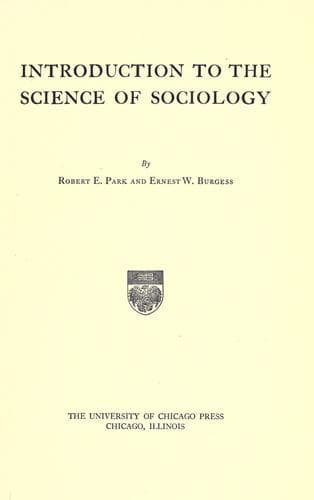
Introduction to the Science of SociologyPark, Robert Ezra
General
Introduction to the Science of Sociology
Park, Robert Ezra
Sociology
_Like commensals._--When a plant-community consists solely of
individuals belonging to one species--for example, solely of beech,
ling, or Aira flexuosa--then we have the purest example of like
commensals. These all make the same demands as regards nutriment, soil,
light, and other like conditions; as each species requires a certain
amount of space and as there is scarcely ever sufficient nutriment for
all the offspring, a struggle for food arises among the plants so soon
as the space is occupied by the definite numbers of individuals which,
according to the species, can develop thereon. The individuals lodged in
unfavorable places and the weaklings are vanquished and exterminated.
This competitive struggle takes place in all plant-communities, with
perhaps the sole exceptions of sub-glacial communities and in deserts.
In these _open communities_ the soil is very often or always so open and
so irregularly clothed that there is space for many more individuals
than are actually present; the cause for this is obviously to be sought
in the climatically unfavorable conditions of life, which either prevent
plants from producing seed and other propagative bodies in sufficient
numbers to clothe the ground or prevent the development of seedlings. On
such soil one can scarcely speak of a competitive struggle for
existence; in this case a struggle takes place between the plant and
inanimate nature, but to little or no extent between plant and plant.
That a congregation of individuals belonging to one species into one
community may be profitable to the species is evident; it may obviously
in several ways aid in maintaining the existence of the species, for
instance, by facilitating abundant and certain fertilization (especially
in anemophilous plants) and maturation of seeds; in addition, the social
mode of existence may confer other less-known advantages. But, on the
other hand, it brings with it greater danger of serious damage and
devastation wrought by parasites.
Public-domain text, read in full here on John Shaqi.
Reviews
Reviews
No reviews yet
Be the first to share your thoughts on this work.
Elsewhere in the archive
Join the Discussion
Join the discussion
Sign in to leave a comment or review.
Sign InorCreate an account