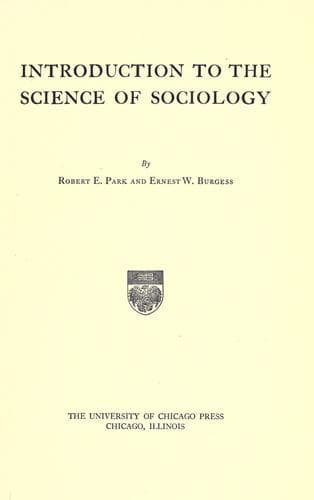
Introduction to the Science of SociologyPark, Robert Ezra
General
Introduction to the Science of Sociology
Park, Robert Ezra
Sociology
There are certain points of resemblance between communities of plants
and those of human beings or animals; one of these is the competition
for food which takes place between similar individuals and causes the
weaker to be more or less suppressed. But far greater are the
distinctions. The plant-community is the lowest form; it is merely a
congregation of units, among which there is no co-operation for the
common weal, but rather a ceaseless struggle of all against all. Only in
a loose sense can we speak of certain individuals protecting others, as
for example, when the outermost and most exposed individuals of scrub
serve to shelter from the wind others, which consequently become taller
and finer; for they do not afford protection from any special motive,
such as is met with in some animal communities, nor are they in any way
specially adapted to act as guardians against a common foe. In the
plant-community egoism reigns supreme. The plant-community has no higher
units or personages in the sense employed in connection with human
communities, which have their own organizations and their members
co-operating, as prescribed by law, for the common good. In
plant-communities there is, it is true, often (or always) a certain
natural dependence or reciprocal influence of many species upon one
another; they give rise to definite organized units of a higher order;
but there is no thorough or organized division of labor such as is met
with in human and animal communities, where certain individuals or
groups of individuals work as organs, in the wide sense of the term, for
the benefit of the whole community.
Woodhead has suggested the term _complementary association_ to denote a
community of species that live together in harmony, because their
rhizomes occupy different depths in the soil; for example, he described
an "association" in which Holcus mollis is the "surface plant," Pteris
aquilina has deeper-seated rhizomes, and Scilla festalis buries its
bulbs at the greatest depth. The photophilous parts of these plants are
"seasonably complementary." The opposite extreme is provided by
_competitive associations_, composed of species that are battling with
each other.
2. Ant Society[85]
There is certainly a striking parallelism between the development of
human and ant societies. Some anthropologists, like Topinard,
distinguish in the development of human societies six different types or
stages, designated as the hunting, pastoral, agricultural, commercial,
industrial, and intellectual. The ants show stages corresponding to the
first three of these, as Lubbock has remarked.
Public-domain text, read in full here on John Shaqi.
Reviews
Reviews
No reviews yet
Be the first to share your thoughts on this work.
Elsewhere in the archive
Join the Discussion
Join the discussion
Sign in to leave a comment or review.
Sign InorCreate an account