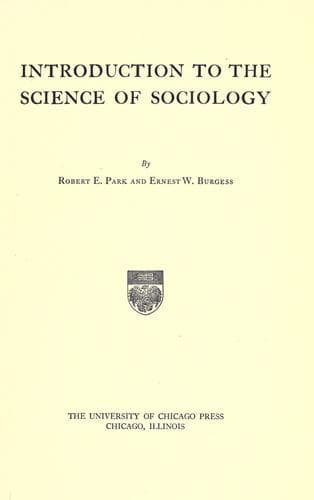
Introduction to the Science of SociologyPark, Robert Ezra
General
Introduction to the Science of Sociology
Park, Robert Ezra
Sociology
b) In human society, apart from the functions depending on sexual
dimorphism, and barring individual differences and deficiencies which
can be partially or wholly suppressed, equalized, or augmented by an
elaborate system of education, all individuals have the same natural
endowment. Each normal individual retains its various physiological and
psychological needs and powers intact, not necessarily sacrificing any
of them for the good of the community. In ants, however, the female
individuals, of which the society properly consists, are not all alike
but often very different, both in their structure (polymorphism) and in
their activities (physiological division of labor). Each member is
_visibly_ predestined to certain social activities to the exclusion of
others, not as a man through the education of some endowment common to
all the members of the society, but through the exigencies of structure,
fixed at the time of hatching, i.e., the moment the individual enters on
its life as an active member of the community.
c) Owing to this pre-established structure and the specialized
functions which it implies, ants are able to live in a condition of
anarchistic socialism, each individual instinctively fulfilling the
demands of social life without "guide, overseer, or ruler," as Solomon
correctly observed, but not without the imitation and suggestion
involved in an appreciation of the activities of its fellows.
An ant society, therefore, may be regarded as little more than an
expanded family, the members of which co-operate for the purpose of
still further expanding the family and detaching portions of itself to
found other families of the same kind. There is thus a striking analogy,
which has not escaped the philosophical biologist, between the ant
colony and the cell colony which constitutes the body of a Metazoan
animal; and many of the laws that control the cellular origin,
development, growth, reproduction, and decay of the individual Metazoan,
are seen to hold good also of the ant society regarded as an individual
of a higher order. As in the case of the individual animal, no further
purpose of the colony can be detected than that of maintaining itself
in the face of a constantly changing environment till it is able to
reproduce other colonies of a like constitution. The queen-mother of the
ant colony displays the generalized potentialities of all the
individuals, just as the Metazoan egg contains _in potentia_ all the
other cells of the body. And, continuing the analogy, we may say that
since the different castes of the ant colony are morphologically
specialized for the performance of different functions, they are truly
comparable with the differentiated tissues of the Metazoan body.
C. HUMAN SOCIETY
1. Social Life[86]
Public-domain text, read in full here on John Shaqi.
Reviews
Reviews
No reviews yet
Be the first to share your thoughts on this work.
Elsewhere in the archive
Join the Discussion
Join the discussion
Sign in to leave a comment or review.
Sign InorCreate an account