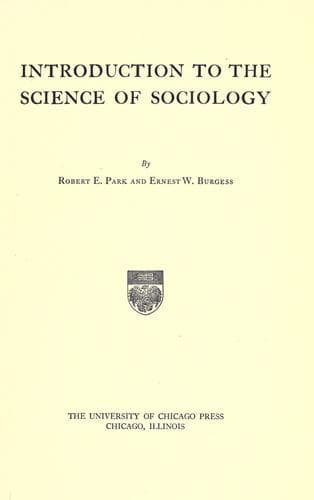
Introduction to the Science of SociologyPark, Robert Ezra
General
Introduction to the Science of Sociology
Park, Robert Ezra
Sociology
Human beings are, however, not merely organisms: they are the home and
the habitat of minuter organisms. The human body is, in a certain sense,
an organization--a sort of social organization--of the minute and simple
organisms of which it is composed, namely, the cells, each of which has
its own characteristic mode of behavior. In fact, the life of human
beings, just as the life of all other creatures above the simple
unicellular organisms, may be said to consist of the corporate life of
the smaller organisms of which it is composed. In human beings, as in
some great city, the division of labor among the minuter organisms has
been carried further, the interdependence of the individual parts is
more complete, and the corporate life of the whole more complex.
It is not strange, therefore, that Lloyd Morgan begins his studies of
animal behavior by a description of the behavior of the cells and
Thorndike in his volume, _The Original Nature of Man_, is led to the
conclusion that the original tendencies of man have their basis in the
neurones, or nerve cells, and in the changes which these cells and their
ancestors have undergone, as a result of the necessity of carrying on
common and corporate existences as integral parts of the human organism.
All acquired characteristics of men, everything that they learn, is due
to mutual stimulations and associations of the neurones, just as
sociologists are now disposed to explain civilization and progress as
phenomena due to the interaction and association of human beings, rather
than to any fundamental changes in human nature itself. In other words,
the difference between a savage and a civilized man is not due to any
fundamental differences in their brain cells but to the connections and
mutual stimulations which are established by experience and education
between those cells. In the savage those possibilities are not absent
but latent. In the same way the difference between the civilization of
Central Africa and that of Western Europe is due, not to the difference
in native abilities of the individuals and the peoples who have created
them, but rather to the form which the association and interaction
between those individuals and groups of individuals has taken. We
sometimes attribute the difference in culture which we meet among races
to the climate and physical conditions generally, but, in the long run,
the difference is determined by the way in which climate and physical
condition determine the contacts and communications of individuals.
Public-domain text, read in full here on John Shaqi.
Reviews
Reviews
No reviews yet
Be the first to share your thoughts on this work.
Elsewhere in the archive
Join the Discussion
Join the discussion
Sign in to leave a comment or review.
Sign InorCreate an account