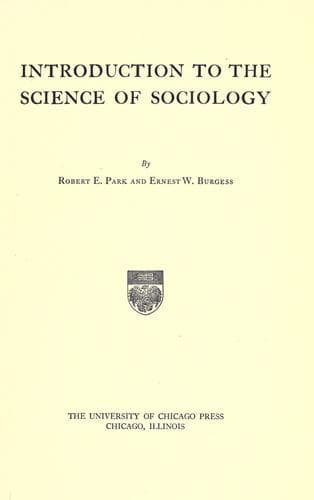
Introduction to the Science of SociologyPark, Robert Ezra
General
Introduction to the Science of Sociology
Park, Robert Ezra
Sociology
Morale, for all the greater purposes of war, is a state of faith; and
its logic will be the superb and elusive logic of human faith. It is for
this reason that morale, while not identical with the righteousness of
the cause, can never reach its height unless the aim of the war can be
held intact in the undissembled moral sense of the people. This is one
of the provisions in the deeper order of things for the slow
predominance of the better brands of justice.
There are still officers in army and navy--not as many as formerly--who
believe exclusively in the morale that works its way into every body of
recruits through discipline and the sway of _esprit de corps_. "They
know that they're here to can the Kaiser, and that's all they need to
know," said one such officer to me very recently. "After a man has been
here two months, the worst punishment you can give him is to tell him he
can't go to France right away. The soldier is a man of action; and the
less thinking he does, the better." There is an amount of practical
wisdom in this; for the human mind has a large capacity for adopting
beliefs that fit the trend of its habits and feelings, and this trend is
powerfully molded by the unanimous direction of an army's purpose. There
is an all but irresistible orthodoxy within a body committed to a war.
And the current (pragmatic) psychology referred to, making the
intelligence a mere instrument of the will, would seem to sanction the
maxim, "First decide, and then think accordingly."
But there are two remarks to be made about this view; first, that in the
actual creation of morale within an army corps much thinking is
included, and nothing is accomplished without the consent of such
thoughts as a man already has. Training does wonders in making morale,
when nothing in the mind opposes it. Second, that the morale which is
sufficient for purposes of training is not necessarily sufficient for
the strains of the field.
The intrinsic weakness of "affective morale," as psychologists call it,
is that it puts both sides on the same mental and moral footing: it
either justifies our opponents as well as ourselves, or it makes both
sides the creatures of irrational emotion.
Crowds are capable of doing reasonless things upon impulse and of
adopting creeds without reflection. But an army is not a crowd; still
less is a nation a crowd. A mob or crowd is an unorganized group of
people governed by less than the average individual intelligence of its
members. Armies and nations are groups of people so organized that they
are controlled by an intelligence higher than the average. The instincts
that lend, and must lend, their immense motive-power to the great
purposes of war are the servants, not the masters, of that
intelligence.
III. INVESTIGATIONS AND PROBLEMS
1. The Scientific Study of Societies
Public-domain text, read in full here on John Shaqi.
Reviews
Reviews
No reviews yet
Be the first to share your thoughts on this work.
Elsewhere in the archive
Join the Discussion
Join the discussion
Sign in to leave a comment or review.
Sign InorCreate an account