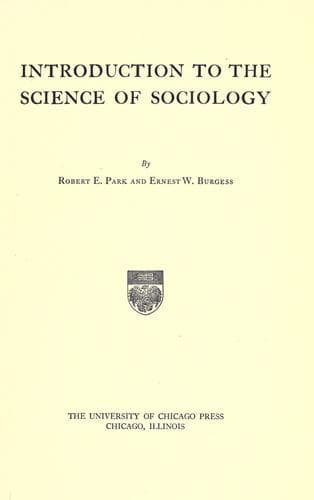
Introduction to the Science of SociologyPark, Robert Ezra
General
Introduction to the Science of Sociology
Park, Robert Ezra
Sociology
The values of prayer in sickness, distress, and doubt are by no means
measurable by the degree to which the primary causes thereof are made to
disappear. There is a real conquest of trouble, even while trouble
remains. It is sometimes a great source of strength, also, merely to
realize that one is fully understood. The value of having some friend or
helper from whom I reserve no secrets has been rendered more impressive
than ever by the Freud-Jung methods of relieving mental disorders
through (in part) a sort of mental house-cleaning, or bringing into the
open the patient's hidden distresses and even his most intimate and
reticent desires. Into the psychology of the healings that are brought
about by this psychoanalysis we need not go, except to note that one
constant factor appears to be the turning of a private possession into a
social possession, and particularly the consciousness that another
understands. I surmise that we shall not be far from the truth here if
we hold that, as normal experience has the _ego-alter_ form, so the
continuing possession of one's self in one's developing experience
requires development of this relation. We may, perhaps, go as far as to
believe that the bottling up of any experience as merely private is
morbid. But, however this may be, there are plenty of occasions when the
road to poise, freedom, and joy is that of social sharing. Hence the
prayer of confession, not only because it helps us to see ourselves as
we are, but also because it shares our secrets with another, has great
value for organizing the self. In this way we get relief from the
misjudgments of others, also, and from the mystery that we are to
ourselves, for we lay our case, as it were, before a judge who does not
err. Thus prayer has value in that it develops the essentially social
form of personal self-realization.
To complete this functional view of prayer we must not fail to secure
the evolutionary perspective. If we glance at the remote beginnings, and
then at the hither end, of the evolution of prayer we discover that an
immense change has taken place. It is a correlate of the transformed
character of the gods, and of the parallel disciplining of men's
valuations. In the words of Fosdick, prayer may be considered as
dominant desire. But it is also a way of securing domination over
desire. It is indeed self-assertion; sometimes it is the making of one's
supreme claim, as when life reaches its most tragic crisis; yet it is,
even in the same act, submission to an over-self. Here, then, is our
greater problem as to the function of prayer. It starts as the assertion
of any desire; it ends as _the organization of one's own desires into a
system of desires recognized as superior and then made one's own_.
4. Isolation, Originality, and Erudition[98]
Public-domain text, read in full here on John Shaqi.
Reviews
Reviews
No reviews yet
Be the first to share your thoughts on this work.
Elsewhere in the archive
Join the Discussion
Join the discussion
Sign in to leave a comment or review.
Sign InorCreate an account