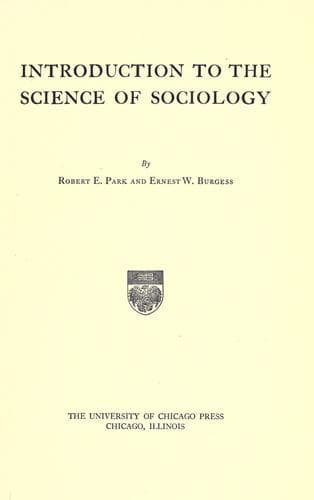
Introduction to the Science of SociologyPark, Robert Ezra
General
Introduction to the Science of Sociology
Park, Robert Ezra
Sociology
time I formed a habit of returning, animal-like, to repose at that same
spot.
It was perhaps a mistake to say that I would sit down and rest, since I
was never tired: and yet, without being tired, that noonday pause,
during which I sat for an hour without moving, was strangely grateful.
All day there would be no sound, not even the rustle of a leaf. One day
while _listening_ to the silence, it occurred to my mind to wonder what
the effect would be if I were to shout aloud. This seemed at the time a
horrible suggestion, which almost made me shudder; but during those
solitary days it was a rare thing for any thought to cross my mind. In
the state of mind I was in, thought had become impossible. My state was
one of _suspense_ and _watchfulness_; yet I had no expectation of
meeting with an adventure, and felt as free from apprehension as I feel
now when sitting in a room in London. The state seemed familiar rather
than strange, and accompanied by a strong feeling of elation; and I did
not know that something had come between me and my intellect until I
returned to my former self--to thinking, and the old insipid existence.
I had undoubtedly _gone back_, and that state of intense watchfulness,
or alertness rather, with suspension of the higher intellectual
faculties, represented the mental state of the pure savage. He thinks
little, reasons little, having a surer guide in his instincts; he is in
perfect harmony with nature, and is nearly on a level, mentally, with
the wild animals he preys on, and which in their turn sometimes prey on
him.
4. Isolation, and the Rural Mind[108]
As an occupation farming has dealt largely, if not exclusively, with the
growth and care of plant and animal life. Broadly speaking, the farmer
has been engaged in a struggle with nature to produce certain staple
traditional raw foods and human comfort materials in bulk. He has been
excused, on the whole, from the delicate situations arising from the
demands of an infinite variety of human wishes, whims, and fashions,
perhaps because the primary grains, fruits, vegetables, fibers, animals,
and animal products, have afforded small opportunity for manipulation to
satisfy the varying forms of human taste and caprice. This exemption of
the farmer in the greater part of his activity from direct work upon and
with persons and from strenuous attempts to please persons, will
doubtless account very largely, perhaps more largely than mere isolation
on the land, for the strong individualism of the country man.
Public-domain text, read in full here on John Shaqi.
Reviews
Reviews
No reviews yet
Be the first to share your thoughts on this work.
Elsewhere in the archive
Join the Discussion
Join the discussion
Sign in to leave a comment or review.
Sign InorCreate an account