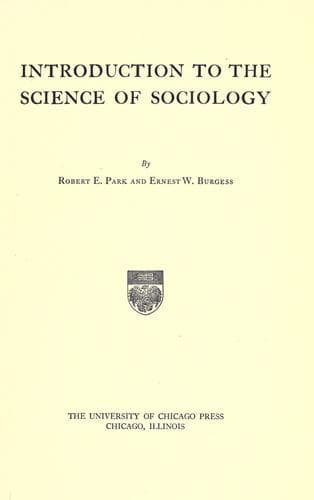
Introduction to the Science of SociologyPark, Robert Ezra
General
Introduction to the Science of Sociology
Park, Robert Ezra
Sociology
The mechanics of modern culture is complicated. The individual has
access to materials outside his group, from the world at large. His
consciousness is built up not only by word of mouth but by the printed
page. He may live as much in German books as in fireside conversation.
Much more mail is handled every day in the New York post-office than was
sent out by all the thirteen states in a year at the close of the
eighteenth century. But by reason of poverty, geographical isolation,
caste feeling, or "pathos," individuals, communities, and races may be
excluded from some of the stimulations and copies which enter into a
high grade of mind. The savage, the Negro, the peasant, the slum
dwellers, and the white woman are notable sufferers by exclusion.
Easy communication of ideas favors differentiation of a
rational and functional sort, as distinguished from the random
variations fostered by isolation. And it must be remembered
that any sort is rational and functional that really commends
itself to the human spirit. Even revolt from an ascendant type
is easier now than formerly because the rebel can fortify
himself with the triumphant records of the non-conformers of
the past.
The peasant [at the middle of the nineteenth century], limited
in a cultural respect to his village life, thinks, feels, and
acts solely in the bounds of his native village; his thought
never goes beyond his farm and his neighbor; toward the
political, economic, or national events taking place outside of
his village, be they of his own or of a foreign country, he is
completely indifferent, and even if he has learned something of
them, this is described by him in a fantastic, mythological
way, and only in this adopted form is it added to his cultural
condition and transmitted to his descendants. Every peasant
farm produced almost exclusively for itself, only to the most
limited extent for exchange; every village formed an economic
unit, which stood in only a loose economic connection with the
outer world. Outwardly complete isolation of the village
settlements and their inhabitants from each other and from the
rest of the country and other classes of society; inwardly
complete homogeneity, one and the same economic, social, and
cultural equality of the peasant mass, no possibility of
advance for the more gifted and capable individuals, everyone
pressed down to a flat level. The peasant of one village holds
himself, if not directly hostile, at least as a rule not
cordial to the peasants of another village. The nobles living
in the same village territory even wanted to force upon the
peasants an entirely different origin, in that with the
assistance of the Biblical legend they wished to trace him from
the accursed Ham (from this the curse and insult _Ty chamie_,
Public-domain text, read in full here on John Shaqi.
Reviews
Reviews
No reviews yet
Be the first to share your thoughts on this work.
Elsewhere in the archive
Join the Discussion
Join the discussion
Sign in to leave a comment or review.
Sign InorCreate an account