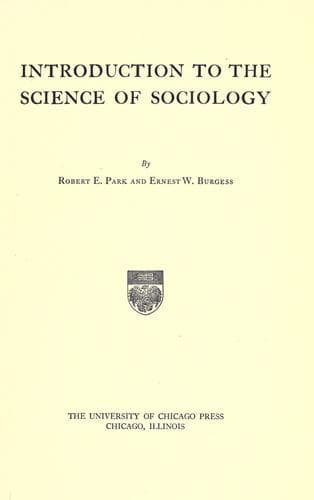
Introduction to the Science of SociologyPark, Robert Ezra
General
Introduction to the Science of Sociology
Park, Robert Ezra
Sociology
By this time our suspicions are aroused. The argument is too simple. Its
conclusions are too far-reaching. By this we do not mean to deny the
facts of geographical distribution in the least. It is only the validity
of the ethnic explanation which we deny. We can do better for our races
than even its best friends along such lines of proof. With the data at
our disposition there is no end to the racial attributes which we might
saddle upon our ethnic types. Thus, it would appear that the Alpine type
in its sterile areas of isolation was the land-hungry one described by
Zola in his powerful novels. For, roughly speaking, individual
land-holdings are larger in them on the average than among the Teutonic
populations. Peasant proprietorship is more common also; there are fewer
tenant farmers. Crime in the two areas assumes a different aspect. We
find that among populations of Alpine type, in the isolated uplands,
offenses against the person predominate in the criminal calendar. In the
Seine basin, along the Rhone Valley, wherever the Teuton is in evidence,
on the other hand, there is less respect for property; so that offenses
against the person, such as assault, murder, and rape, give place to
embezzlements, burglary, and arson. It might just as well be argued that
the Teuton shows a predilection for offenses against property; the
native Celt an equal propensity for crimes against the person.
Appeal to the social geography of other countries, wherein the ethnic
balance of power is differently distributed, may be directed against
almost any of the phenomena we have instanced in France as seemingly of
racial derivation. In the case either of suicide or divorce, if we turn
from France to Italy or Germany, we instantly perceive all sorts of
contradictions. The ethnic type, which is so immune from propensity to
self-destruction or domestic disruption in France, becomes in Italy most
prone to either mode of escape from temporary earthly ills. For each
phenomenon culminates in frequency in the northern half of the latter
country, stronghold of the Alpine race. Nor is there an appreciable
infusion of Teutonism, physically speaking, herein, to account for the
change of heart. Of course, it might be urged that this merely shows
that the Mediterranean race of southern Italy is as much less inclined
to the phenomenon than the Alpine race in these respects, as it in turn
lags behind the Teuton. For it must be confessed that even in Italy
neither divorce nor suicide is so frequent anywhere as in Teutonic
northern France. Well, then, turn to Germany. Compare its two halves in
these respects again. The northern half of the empire is most purely
Teutonic by race; the southern is not distinguishable ethnically, as we
have sought to prove, from central France. Bavaria, Baden, and
Würtemberg are scarcely more Teutonic by race than Auvergne. Do we find
differences in suicide, for example, following racial boundaries here?
Public-domain text, read in full here on John Shaqi.
Reviews
Reviews
No reviews yet
Be the first to share your thoughts on this work.
Elsewhere in the archive
Join the Discussion
Join the discussion
Sign in to leave a comment or review.
Sign InorCreate an account