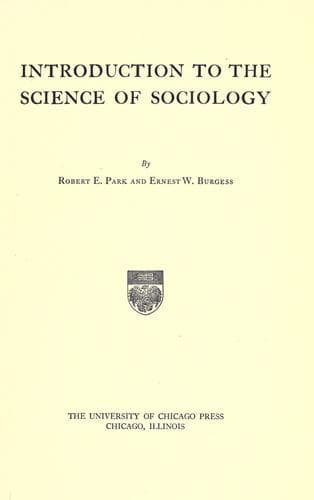
Introduction to the Science of SociologyPark, Robert Ezra
General
Introduction to the Science of Sociology
Park, Robert Ezra
Sociology
Beginnings have been made in child study, psychiatry, and psychoanalysis
of the effects of different types of isolation upon personal
development. Some attention has been given to the study of effects upon
mentality and personality of physical defects such as deaf-mutism and
blindness. Students of the so-called "morally defective child," that is
the child who appears deficient in emotional and sympathetic responses,
suggest as a partial explanation the absence in infancy and early
childhood of intimate and sympathetic contacts with the mother. An
investigation not yet made but of decisive bearing upon this point will
be a comparative study of children brought up in families with those
reared in institutions.
Psychiatry and psychoanalysis in probing mental life and personality
have related certain mental and social abnormalities to isolation from
social contact. Studies of paranoia and of egocentric personalities have
resulted in the discovery of the only or favorite child complex. The
exclusion of the boy or girl in the one-child family from the give and
take of democratic relations with brothers and sisters results,
according to the theory advanced, in a psychopathic personality of the
self-centered type. A contributing cause of homosexuality, it is said by
psychoanalysts, is the isolation during childhood from usual association
with individuals of the same sex. Research in dementia praecox discloses
a symptom and probably a cause of this mental malady to be the
withdrawal of the individual from normal social contacts and the
substitution of an imaginary for a real world of persons and events.
Dementia praecox has been related by one psychoanalyst to the "shut-in"
type of personality.
The literature on the subject of privacy in its relation to personal
development is fragmentary but highly promising for future research. The
study of the introspective type of personality suggests that
self-analysis is the counterpart of the inhibition of immediate and
impulsive self-expression in social relations. Materials for an
understanding of the relation of retirement and privacy to the
aesthetic, moral, and creative life of the person may be found in the
lives of hermits, inventors, and religious leaders; in the studies of
seclusion, prayer, and meditation; and in research upon taboo, prestige,
and attitudes of superiority and inferiority.
BIBLIOGRAPHY: MATERIALS FOR THE STUDY OF ISOLATION
I. CHARACTERISTIC SENTIMENTS AND ATTITUDES OF THE ISOLATED PERSON
(1) Zimmermann, Johann G. _Solitude._ Or the effects of occasional
retirement on the mind, the heart, general society. Translated from the
German. London, 1827.
(2) Canat, René. _Une forme du mal du siècle._ Du sentiment de la
solitude morale chez les romantiques et les parnassiens. Paris, 1904.
(3) Goltz, E. von der. _Das Gebet in der aeltesten Christenheit._
Leipzig, 1901.
(4) Strong, Anna L. _A Consideration of Prayer from the Standpoint of
Social Psychology._ Chicago, 1908.
Public-domain text, read in full here on John Shaqi.
Reviews
Reviews
No reviews yet
Be the first to share your thoughts on this work.
Elsewhere in the archive
Join the Discussion
Join the discussion
Sign in to leave a comment or review.
Sign InorCreate an account