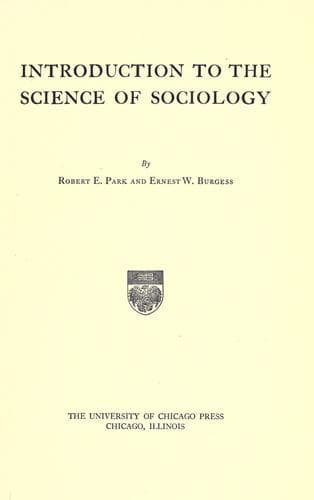
Introduction to the Science of SociologyPark, Robert Ezra
General
Introduction to the Science of Sociology
Park, Robert Ezra
Sociology
4. Isolation, Segregation, and the Physically Defective: as the Blind,
the Deaf-Mute, the Physically Handicapped.
5. Isolated Areas and Cultural Retardation: the Southern Mountaineer,
Pitcairn Islanders, the Australian Aborigines.
6. "Moral" Areas, Isolation, and Segregation: City Slums, Vice
Districts, "Breeding-places of Crime."
7. The Controlled versus the Natural process of Segregation of the
Feeble-minded.
8. Isolation and Insanity.
9. Privacy in the Home.
10. Isolation and Prestige.
11. Isolation as a Defence against the Invasion of Personality.
12. Nationalism as a Form of Isolation.
13. Biological and Social Immunity: or Biological Immunity from
Infection, Personal or Group Immunity against Social Contagion.
14. The Only Child.
15. The Pathological Liar Considered from the Point of View of
Isolation.
QUESTIONS FOR DISCUSSION
1. Is the distinction between isolation and social contact relative or
absolute?
2. What illustrations of the various forms of isolation, spatial,
structural, habitudinal, and psychical, occur to you?
3. By what process does isolation cause racial differentiation?
4. What is the relation of endogamy and exogamy (a) to isolation, and
(b) to the establishment of a successful stock or race?
5. In what ways do the Jews and the Americans as racial types illustrate
the effects of isolation and of contact?
6. What do you understand to be Bacon's definition of solitude?
7. What is the point in the saying "A great town is a great solitude"?
8. What is the sociology of the creation by a solitary person of
imaginary companions?
9. Under what conditions does an individual prefer solitude to society?
Give illustrations.
10. What are the devices used in prayer to secure isolation?
11. "Prayer has value in that it develops the essentially social form of
personal self-realization." Explain.
12. What are the interrelations of social contact and of privacy in the
development of the ideal self?
13. What do you understand by the relation of erudition to originality?
14. In what ways does isolation (a) promote, (b) impede,
originality? What other factors beside isolation are involved in
originality?
15. What is the value of privacy?
16. What was the value of the monasteries?
17. What conclusions do you derive from the study of the cases of feral
men? Do these cases bear out the theory of Aristotle in regard to the
effect of isolation upon the individual?
18. What is the significance of Helen Keller's account of how she broke
through the barriers of isolation?
19. What were the mental effects of solitude described by Hudson? How do
you explain the difference between the descriptions of the effect of
solitude in the accounts given by Rousseau and by Hudson?
20. How does Galpin explain the relation of isolation to the development
of the "rural mind"?
21. What are the effects of isolation upon the young man or young woman
reared in the country?
Public-domain text, read in full here on John Shaqi.
Reviews
Reviews
No reviews yet
Be the first to share your thoughts on this work.
Elsewhere in the archive
Join the Discussion
Join the discussion
Sign in to leave a comment or review.
Sign InorCreate an account