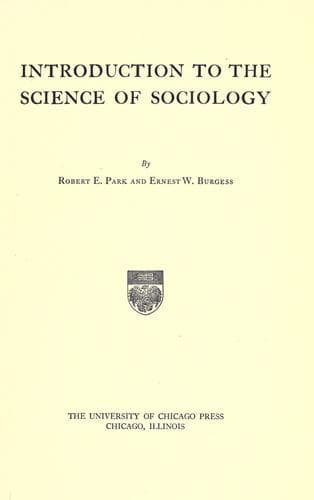
Introduction to the Science of SociologyPark, Robert Ezra
General
Introduction to the Science of Sociology
Park, Robert Ezra
Sociology
b) _Touch as the physiological basis of social contact._--According to
the spatial conception the closest contacts possible are those of touch.
The physical proximity involved in tactile sensations is, however, but
the symbol of the intensity of the reactions to contact. Desire and
aversion for contacts, as Crawley shows in his selection, arise in the
most intimate relations of human life. Love and hate, longing and
disgust, sympathy and hostility increase in intensity with intimacy of
association. It is a current sociological fallacy that closeness of
contact results only in the growth of good will. The fact is, that with
increasing contact either attraction or repulsion may be the outcome,
depending upon the situation and upon factors not yet fully analyzed.
Peculiar conditions of contact, as its prolonged duration, its frequent
repetition, just as in the case of isolation from normal association,
may lead to the inversion of the original impulses and sentiments of
affection and antipathy.[117]
c) _Contacts with the "in-group" and with the "out-group."_--The
conception of the we-group in terms of distance is that of a group in
which the solidarity of units is so complete that the movements and
sentiments of all are completely regulated with reference to their
interests and behavior as a group. This control by the in-group over its
members makes for solidity and impenetrability in its relations with the
out-group. Sumner in his _Folkways_ indicates how internal sympathetic
contacts and group egotism result in double standards of behavior:
good-will and co-operation within the members of the in-group, hostility
and suspicion toward the out-group and its members. The essential point
is perhaps best brought out by Shaler in his distinction between
sympathetic and categoric contacts. He describes the transition from
contacts of the out-group to those of the in-group, or from remote to
intimate relations. From a distance, a person has the characteristics of
his group, upon close acquaintance he reveals his individuality.
d) _Historical continuity and mobility._--Historical continuity, which
maintains the identity of the present with the past, implies the
existence of a body of tradition which is transmitted from the older to
the younger generations. Through the medium of tradition, including in
that term all the learning, science, literature, and practical arts, not
to speak of the great body of oral tradition which is after all a larger
part of life than we imagine, the historical and cultural life is
maintained. This is the meaning of the long period of childhood in man
during which the younger generation is living under the care and
protection of the older. When, for any reason, this contact of the
younger with the older generation is interrupted--as is true in the case
of immigrants--a very definite cultural deterioration frequently ensues.
Public-domain text, read in full here on John Shaqi.
Reviews
Reviews
No reviews yet
Be the first to share your thoughts on this work.
Elsewhere in the archive
Join the Discussion
Join the discussion
Sign in to leave a comment or review.
Sign InorCreate an account