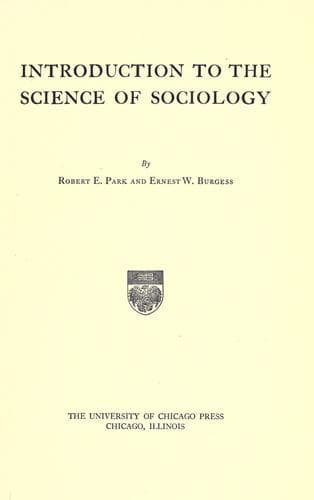
Introduction to the Science of SociologyPark, Robert Ezra
General
Introduction to the Science of Sociology
Park, Robert Ezra
Sociology
Durkheim is sometimes referred to, in comparison with other contemporary
sociologists, as a realist. This is a reference to the controversy of
the medieval philosophers in regard to the nature of concepts. Those who
thought a concept a mere class-name applied to a group of objects
because of some common characteristics were called nominalists. Those
who thought the concept was _real_, and not the name of a mere
collection of individuals, were realists. In this sense Tarde and
Giddings and all those writers who think of society as a collection of
actually or potentially _like-minded_ persons would be nominalists,
while other writers like Simmel, Ratzenhofer, and Small, who think of
society in terms of interaction and social process may be called
realists. They are realist, at any rate, in so far as they think of the
members of a society as bound together in a system of mutual influences
which has sufficient character to be described as a process.
Naturally this process cannot be conceived of in terms of space or
physical proximity alone. Social contacts and social forces are of a
subtler sort but not less real than physical. We know, for example, that
vocations are largely determined by personal competition; that the
solidarity of what Sumner calls the "in" or "we" group is largely
determined by its conflict with the "out" or "other" groups. We know,
also, that the status and social position of any individual inside any
social group is determined by his relation to all other members of that
group and eventually of all other groups. These are illustrations of
what is meant concretely by social interaction and social process and it
is considerations of this kind which seem to justify certain writers in
thinking of individual persons as "parts" and of society as a "whole" in
some other sense than that in which a dust heap is a whole of which the
individual particles are parts.
Society not only continues to exist _by_ transmission, _by_
communication, but it may fairly be said to exist _in_
transmission, _in_ communication. There is more than a verbal
tie between the words common, community, and communication.[39]
Communication, if not identical with, is at least a form of, what has
been referred to here as social interaction. But communication as Dewey
has defined the term, is something more and different than what Tarde
calls "inter-stimulation." Communication is a process by which we
"transmit" an experience from an individual to another but it is also a
process by which these same individuals get a common experience.
Public-domain text, read in full here on John Shaqi.
Reviews
Reviews
No reviews yet
Be the first to share your thoughts on this work.
Join the Discussion
Join the discussion
Sign in to leave a comment or review.
Sign InorCreate an account