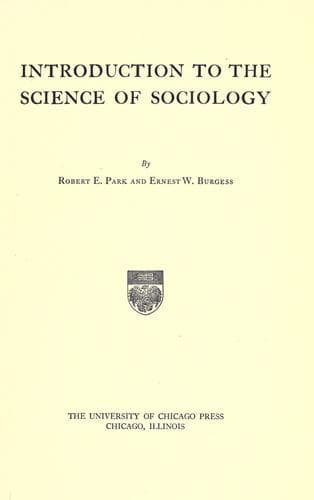
Introduction to the Science of SociologyPark, Robert Ezra
General
Introduction to the Science of Sociology
Park, Robert Ezra
Sociology
The oldest but most persistent form of social technique is that
of "ordering-and-forbidding"--that is, meeting a crisis by an
arbitrary act of will decreeing the disappearance of the
undesirable or the appearance of the desirable phenomena, and
the using arbitrary physical action to enforce the decree. This
method corresponds exactly to the magical phase of natural
technique. In both, the essential means of bringing a
determined effect is more or less consciously thought to reside
in the act of will itself by which the effect is decreed as
desirable and of which the action is merely an indispensable
vehicle or instrument; in both, the process by which the cause
(act of will and physical action) is supposed to bring its
effect to realization remains out of reach of investigation; in
both, finally, if the result is not attained, some new act of
will with new material accessories is introduced, instead of
trying to find and remove the perturbing causes. A good
instance of this in the social field is the typical legislative
procedure of today.[45]
2. _Types of social group._--The varied interests, fields of
investigation, and practical programs which find at present a place
within the limits of the sociological discipline are united in having
one common object of reference, namely, _the concept of the social
group_. All social problems turn out finally to be problems of group
life, although each group and each type of group has its own
distinctive problems. Illustrations may be gathered from the most
widely separated fields to emphasize the truth of this assertion.[46]
Religious conversion may be interpreted from one point of view as a
change from one social group to another. To use the language of
religious sentiment, the convert "comes out of a life of sin and enters
into a life of grace." To be sure, this change involves profound
disturbances of the personality, but permanence of the change in the
individual is assured by the breaking up of the old and the
establishment of new associations. So the process by which the immigrant
makes the transition from the old country to the new involves profound
changes in thought and habit. In his case the change is likely to take
place slowly, but it is not less radical on that account.
The following paragraph from a recent social survey illustrates, from a
quite different point of view, the manner in which the group is involved
in changes in community life.
Public-domain text, read in full here on John Shaqi.
Reviews
Reviews
No reviews yet
Be the first to share your thoughts on this work.
Elsewhere in the archive
Join the Discussion
Join the discussion
Sign in to leave a comment or review.
Sign InorCreate an account