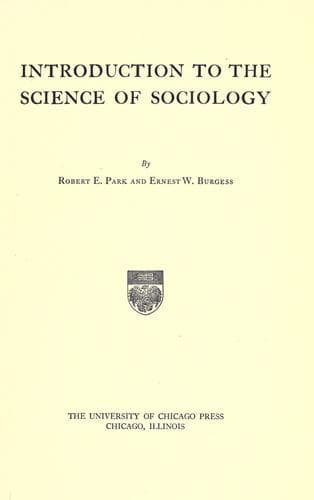
Introduction to the Science of SociologyPark, Robert Ezra
General
Introduction to the Science of Sociology
Park, Robert Ezra
Sociology
To the community the criminal is aggressive. To the criminal
his life is one of defense primarily. The greater part of his
energy, of his hopes, and of his successes, centres around
escapes, around successful flight, around proper covering-up of
his tracks, and around having good, loyal, and trustworthy
friends to participate in his activities, who will tell no
tales and keep the rest of the community outside. The criminal
is thus, from his own point of view--and I am speaking of
professional criminals--living a life of defensive warfare with
the community; and the odds are heavy against him. He therefore
builds up a defensive psychology against it--a psychology of
boldness, bravado, and self-justification. The good
criminal--which means the successful one, he who has most
successfully carried through a series of depradations against
the enemy, the common enemy, the public--is a hero. He is
recognized as such, toasted and feasted, trusted and obeyed.
But always by a little group. They live in a world of their
own, a life of their own, with ideals, habits, outlook,
beliefs, and associations which are peculiarly fitted to
maintain the morale of the group. Loyalty, fearlessness,
generosity, willingness to sacrifice one's self, perseverance
in the face of prosecution, hatred of the common enemy--these
are the elements that maintain the morale, but all of them are
pointed against the community as a whole.[48]
The manner in which the principle of the primary group was applied at
Sing Sing in dealing with the criminal within the prison walls is a
still more interesting illustration of the fact that social problems are
group problems.[49]
Assuming, then, that every social group may be presumed to have its own
(a) administrative, (b) legislative, and (c) human-nature
problems, these problems may be still further classified with reference
to the type of social group. Most social groups fall naturally into one
or the other of the following classes:
a) The family.
b) Language (racial) groups.
c) Local and territorial communities: (i) neighborhoods, (ii) rural
communities, (iii) urban communities.
d) Conflict groups: (i) nationalities, (ii) parties, (iii) sects, (iv)
labor organizations, (v) gangs, etc.
e) Accommodation groups: (i) classes, (ii) castes, (iii) vocational,
(iv) denominational groups.
Public-domain text, read in full here on John Shaqi.
Reviews
Reviews
No reviews yet
Be the first to share your thoughts on this work.
Elsewhere in the archive
Join the Discussion
Join the discussion
Sign in to leave a comment or review.
Sign InorCreate an account