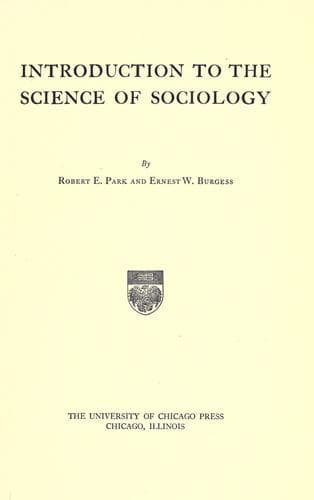
Introduction to the Science of SociologyPark, Robert Ezra
General
Introduction to the Science of Sociology
Park, Robert Ezra
Sociology
4. _Social process and social progress._--Social process is the name for
all changes which can be regarded as changes in the life of the group. A
group may be said to have a life when it has a history. Among social
processes we may distinguish (a) the historical, (b) the cultural,
(c) the political, and (d) the economic.
a) We describe as historical the processes by which the fund of social
tradition, which is the heritage of every permanent social group, is
accumulated and transmitted from one generation to another.
History plays the rôle in the group of memory in the individual. Without
history social groups would, no doubt, rise and decline, but they would
neither grow old nor make progress.
Immigrants, crossing the ocean, leave behind them much of their local
traditions. The result is that they lose, particularly in the second
generation, that control which the family and group tradition formerly
exercised over them; but they are, for that very reason, all the more
open to the influence of the traditions and customs of their adopted
country.
b) If it is the function of the historical process to accumulate and
conserve the common fund of social experience, it is the function of the
cultural process to shape and define the social forms and the social
patterns which each preceding generation imposes upon its successors.
The individual living in society has to fit into a pre-existing
social world, to take part in the hedonistic, economic,
political, religious, moral, aesthetic, intellectual activities
of the group. For these activities the group has objective
_systems_, more or less complex sets of schemes, organized
either by traditional association or with a conscious regard to
the greatest possible efficiency of the result, but with only a
secondary, or even with no interest in the particular desires,
abilities and experiences of the individuals who have to
perform these activities.
There is no pre-existing harmony whatever between the
individual and the social factors of personal evolution, and
the fundamental tendencies of the individual are always in some
disaccordance with the fundamental tendencies of social
control. Personal evolution is always a struggle between the
individual and society--a struggle for self-expression on the
part of the individual, for his subjection on the part of
society--and it is in the total course of this struggle that
the personality--not as a static "essence" but as a dynamic,
continually evolving set of activities--manifests and
constructs itself.[51]
Public-domain text, read in full here on John Shaqi.
Reviews
Reviews
No reviews yet
Be the first to share your thoughts on this work.
Elsewhere in the archive
Join the Discussion
Join the discussion
Sign in to leave a comment or review.
Sign InorCreate an account