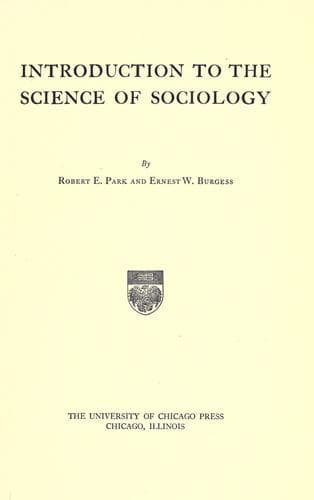
Introduction to the Science of SociologyPark, Robert Ezra
General
Introduction to the Science of Sociology
Park, Robert Ezra
Sociology
(2) Social movements (reorganization) include: (a) crowd movements
(i.e., mobs, strikes, etc.); (b) cultural revivals, religious and
linguistic; (c) fashion (changes in dress, convention, and social
ritual); (d) reform (changes in social policy and administration);
(e) revolutions (changes in institutions and the mores).
5. _The individual and the person._--The person is an individual who has
status. We come into the world as individuals. We acquire status, and
become persons. Status means position in society. The individual
inevitably has some status in every social group of which he is a
member. In a given group the status of every member is determined by his
relation to every other member of that group. Every smaller group,
likewise, has a status in some larger group of which it is a part and
this is determined by its relation to all the other members of the
larger group.
The individual's self-consciousness--his conception of his rôle in
society, his "self," in short--while not identical with his personality
is an essential element in it. The individual's conception of himself,
however, is based on his status in the social group or groups of which
he is a member. The individual whose conception of himself does not
conform to his status is an isolated individual. The completely isolated
individual, whose conception of himself is in no sense an adequate
reflection of his status, is probably insane.
It follows from what is said that an individual may have many "selves"
according to the groups to which he belongs and the extent to which each
of these groups is isolated from the others. It is true, also, that the
individual is influenced in differing degrees and in a specific manner,
by the different types of group of which he is a member. This indicates
the manner in which the personality of the individual may be studied
sociologically.
Every individual comes into the world in possession of certain
characteristic and relatively fixed behavior patterns which we call
instincts. This is his racial inheritance which he shares with all
members of the species. He comes into the world, also, endowed with
certain undefined capacities for learning other forms of behavior,
capacities which vary greatly in different individuals. These individual
differences and the instincts are what is called original nature.[52]
Sociology is interested in "original nature" in so far as it supplies
the raw materials out of which individual personalities and the social
order are created. Both society and the persons who compose society are
the products of social processes working in and through the materials
which each new generation of men contributes to it.
Public-domain text, read in full here on John Shaqi.
Reviews
Reviews
No reviews yet
Be the first to share your thoughts on this work.
Elsewhere in the archive
Join the Discussion
Join the discussion
Sign in to leave a comment or review.
Sign InorCreate an account