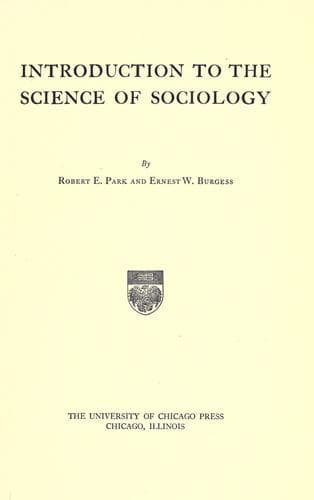
Introduction to the Science of SociologyPark, Robert Ezra
General
Introduction to the Science of Sociology
Park, Robert Ezra
Sociology
Human nature in this sense is justly regarded as a
comparatively permanent element in society. Always and
everywhere men seek honor and dread ridicule, defer to public
opinion, cherish their goods and their children, and admire
courage, generosity, and success. It is always safe to assume
that people are and have been human.
Human nature is not something existing separately in the
individual, but a _group nature or primary phase of society_, a
relatively simple and general condition of the social mind. It
is something more, on the one hand, than the mere instinct that
is born in us--though that enters into it--and something less,
on the other, than the more elaborate development of ideas and
sentiments that makes up institutions. It is the nature which
is developed and expressed in those simple, face-to-face groups
that are somewhat alike in all societies; groups of the family,
the playground, and the neighborhood. In the essential
similarity of these is to be found the basis, in experience,
for similar ideas and sentiments in the human mind. In these,
everywhere, human nature comes into existence. Man does not
have it at birth; he cannot acquire it except through
fellowship, and it decays in isolation.[55]
3. Classification of the Materials
With the tacit acceptance by biologists, psychologists, and sociologists
of human behavior as a natural phenomenon, materials upon human nature
have rapidly accumulated. The wealth and variety of these materials are
all the greater because of the diversity of the points of view from
which workers in this field have attacked the problem. The value of the
results of these investigations is enhanced when they are brought
together, classified, and compared.
The materials fall naturally into two divisions: (a) "The Original
Nature of Man" and (b) "Human Nature and Social Life." This division
is based upon a distinction between traits that are inborn and
characters socially acquired; a distinction found necessary by students
in this field. Selections under the third heading, "Personality and the
Social Self" indicate the manner in which the individual develops under
the social influences, from the raw material of "instinct" into the
social product "the person." Materials in the fourth division,
"Biological and Social Inheritance," contrast the method of the
transmission of original tendencies through the germ plasm with the
communication of the social heritage through education.
Public-domain text, read in full here on John Shaqi.
Reviews
Reviews
No reviews yet
Be the first to share your thoughts on this work.
Elsewhere in the archive
Join the Discussion
Join the discussion
Sign in to leave a comment or review.
Sign InorCreate an account