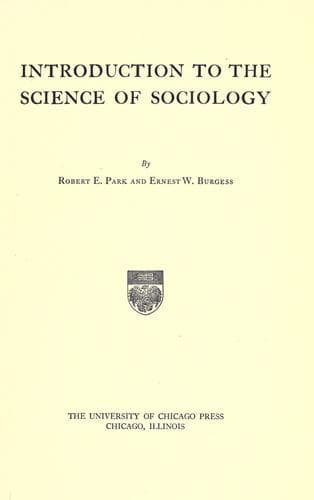
Introduction to the Science of SociologyPark, Robert Ezra
General
Introduction to the Science of Sociology
Park, Robert Ezra
Sociology
c) _Personality and the social self._--The selections upon
"Personality and the Social Self" bring together and compare the
different definitions of the term. These definitions fall under three
heads:
(1) _The organism as personality:_ This is a biological statement,
satisfactory as a definition only as preparatory to further analysis.
(2) _Personality as a complex:_ Personality defined in terms of the
unity of mental life is a conception that has grown up in the recent
"individual psychology," so called. Personality includes, in this case,
not only the memories of the individual and his stream of
consciousness, but also the characteristic organization of mental
complexes and trends which may be thought of as a supercomplex. The
phenomena of double and multiple personalities occur when this unity
becomes disorganized. Disorganization in releasing groups of complexes
from control may even permit the formation of independent organizations.
Morton Prince's book _The Dissociation of a Personality_ is a classic
case study of multiple personality. The selections upon "The Natural
Person versus the Social and Conventional Person" and "The Divided Self
and the Moral Consciousness" indicate the more usual and less extreme
conflicts of opposing sentiments and interests within the organization
of personality.
(3) _Personality as the rôle of the individual in the group:_ The word
personality is derived from the Latin _persona_, a mask used by actors.
The etymology of the term suggests that its meaning is to be found in
the rôle of the individual in the social group. By usage, personality
carries the implication of the social expression of behavior.
Personality may then be defined as the sum and organization of those
traits which determine the rôle of the individual in the group. The
following is a classification of the characteristics of the person which
affect his social status and efficiency:
(a) physical traits, as physique, physiognomy, etc.;
(b) temperament;
(c) character;
(d) social expression, as by facial expression, gesture, manner,
speech, writing, etc.;
(e) prestige, as by birth, past success, status, etc.;
(f) the individual's conception of his rôle.
The significance of these traits consists in the way in which they enter
into the rôle of the individual in his social milieu. Chief among these
may be considered the individual's conception of the part which he plays
among his fellows. Cooley's discriminating description of "the
looking-glass self" offers a picture of the process by which the person
conceives himself in terms of the attitudes of others toward him.
Public-domain text, read in full here on John Shaqi.
Reviews
Reviews
No reviews yet
Be the first to share your thoughts on this work.
Elsewhere in the archive
Join the Discussion
Join the discussion
Sign in to leave a comment or review.
Sign InorCreate an account