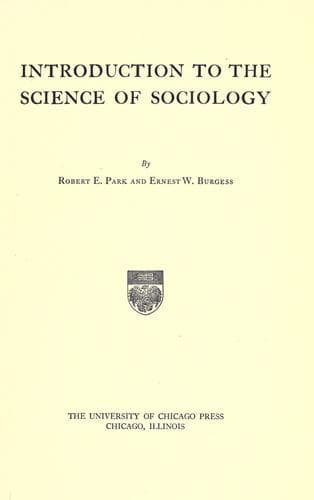
Introduction to the Science of SociologyPark, Robert Ezra
General
Introduction to the Science of Sociology
Park, Robert Ezra
Sociology
The most curious of all the monkey traits shown by the new-born baby is
the one investigated by Dr. Louis Robinson. It was suggested by _The
Luck of Roaring Camp_. The question was raised in conversation whether a
limp and molluscous baby, unable so much as to hold up its head on its
helpless little neck, could do anything so positive as to "rastle with"
Kentuck's finger; and the more knowing persons present insisted that a
young baby does, as a matter of fact, have a good firm hand-clasp. It
occurred to Dr. Robinson that if this was true it was a beautiful
Darwinian point, for clinging and swinging by the arms would naturally
have been a specialty with our ancestors if they ever lived a
monkey-like life in the trees. The baby that could cling best to its
mother as she used hands, feet, and tail to flee in the best time over
the trees, or to get at the more inaccessible fruits and eggs in time of
scarcity, would be the baby that lived to bequeath his traits to his
descendants; so that to this day our housed and cradled human babies
would keep in their clinging powers a reminiscence of our wild treetop
days.
There is another class of movements, often confused with the
reflex--that is, instinctive movements. Real grasping (as distinguished
from reflex grasping), biting, standing, walking, are examples of this
class. They are race movements, the habits of the species to which the
animal belongs, and every normal member of the species is bound to come
to them; yet they are not so fixed in the bodily mechanism as the reflex
movements.
The one instinct the human baby always brings into the world already
developed is half a mere reflex act--that of sucking. It is started as a
reflex would be, by the touch of some object--pencil, finger, or nipple,
it may be--between the lips; but it does not act like a reflex after
that. It continues and ceases without reference to this external
stimulus, and a little later often begins without it, or fails to begin
when the stimulus is given. If it has originally a reflex character,
that character fades out and leaves it a pure instinct.
My little niece evidently felt a difference between light and darkness
from the first hour, for she stopped crying when her face was exposed to
gentle light. Two or three report also a turning of the head toward the
light within the first week. The nurse, who was intelligent and exact,
thought she saw this in the case of my niece. I did not, but I saw
instead a constant turning of the eyes toward a person coming near
her--that is, toward a large dark mass that interrupted the light. No
other sign of vision appeared in the little one during the first
fortnight. The eyes were directed to nothing, fixed on nothing. They did
not wink if one made a pass at them. There was no change of focus for
near or distant seeing.
Public-domain text, read in full here on John Shaqi.
Reviews
Reviews
No reviews yet
Be the first to share your thoughts on this work.
Elsewhere in the archive
Join the Discussion
Join the discussion
Sign in to leave a comment or review.
Sign InorCreate an account