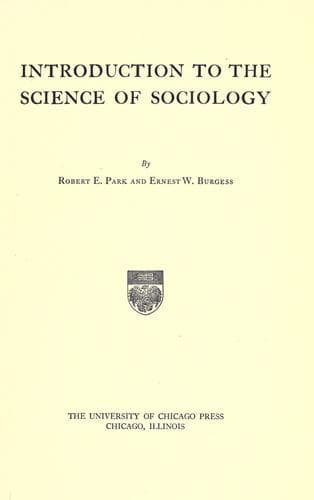
Introduction to the Science of SociologyPark, Robert Ezra
General
Introduction to the Science of Sociology
Park, Robert Ezra
Sociology
The baby's increased interest in seeing centered especially on the faces
about her, at which she gazed with rapt interest. Even during the period
of mere staring, faces had oftenest held her eyes, probably because they
were oftener brought within the range of her clearest seeing than other
light surfaces. The large, light, moving patch of the human face (as
Preyer has pointed out) coming and going in the field of vision, and
oftener chancing to hover at the point of clearest seeing than any other
object, embellished with a play of high lights on cheeks, teeth, and
eyes, is calculated to excite the highest degree of attention a baby is
capable of at a month old. So from the very first--before the baby has
yet really seen his mother--her face and that of his other nearest
friends become the most active agents in his development and the most
interesting things in his experience.
Our baby was at this time in a way aware of the difference between
companionship and solitude. In the latter days of the first month she
would lie contentedly in the room with people near by, but would fret if
left alone. But by the end of the month she was apt to fret when she was
laid down on a chair or lounge, and to become content only when taken
into the lap. This was not yet distinct memory and desire, but it showed
that associations of pleasure had been formed with the lap, and that
she felt a vague discomfort in the absence of these.
Nature has provided an educational appliance almost ideally adapted to
the child's sense condition, in the mother's face, hovering close above
him, smiling, laughing, nodding, with all manner of delightful changes
in the high lights; in the thousand little meaningless caressing sounds,
the singing, talking, calling, that proceed from it; the patting,
cuddling, lifting, and all the ministrations that the baby feels while
gazing at it, and associates with it, till finally they group together
and round out into the idea of his mother as a whole.
Our baby's mother rather resented the idea of being to her baby only a
collection of detached phenomena, instead of a mamma; but the more you
think of it, the more flattering it is to be thus, as it were, dissolved
into your elements and incorporated item by item into the very
foundations of your baby's mental life. Herein is hinted much of the
philosophy of personality; and Professor Baldwin has written a solid
book, mainly to show from the development of babies and little children
that all other people are part of each of us, and each of us is part of
all other people, and so there is really no separate personality, but we
are all one spirit, if we did but know it.
5. Sex Differences[62]
Public-domain text, read in full here on John Shaqi.
Reviews
Reviews
No reviews yet
Be the first to share your thoughts on this work.
Elsewhere in the archive
Join the Discussion
Join the discussion
Sign in to leave a comment or review.
Sign InorCreate an account