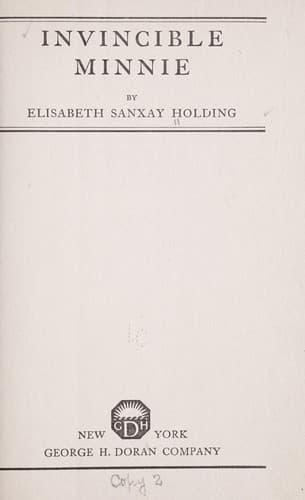
Bigamy -- Fiction; Man-woman relationships -- Fiction; Mothers -- Fiction; Sisters -- Fiction; Young women -- Fiction
The Eagle House was little changed from the days when Frankie had
lunched there, the same four-story, brown brick building with awnings,
much the worse for wear, boldly marked “Eagle House.” It still derived
its support from the “Pool Room and Café,” reached by a separate
entrance, but something had been done for the comfort of the “guest,” as
well--a sun-baked, uneven little tennis court now appeared on the
hitherto vacant lot beside the hotel. Inside it was just as sordid, as
fly-blown, as horribly gloomy.
But Minnie was not fastidious. She discovered that there was at least
one other lady stopping there, the wife of a visiting cotton-mill
magnate, and that satisfied her. With her child by the hand she walked
sedately through the lobby, thick with tobacco smoke, crowded with the
travelling salesmen and the village loafers who composed the clientele
of the Eagle House, and went upstairs to take possession of a tiny
bedroom with a single bed for both of them. It was very cheap and that
was what she required. She unpacked their very few belongings quite
cheerfully and washed the little girl’s face.
“Shan’t we be happy here!” she said.
They were rather late in coming down, and the dining room was full of
men, the waitresses flying round, exchanging sallies with the guests, a
brilliant glare pouring down from an electrolier high overhead. Minnie
stood in the doorway, still holding the child’s hand, a little
bewildered by the noise and bustle and by the frankness with which
everyone turned to regard them. Unassailably respectable, she met and
countered the general regard and with dignity advanced to a little table
in a corner. A book was brought for the little girl to sit on and an
interested waitress presented a grease-spotted menu. They ate their meal
composedly; once in a while the clear voice of the child could be heard
asking a question. It behaved wonderfully well. It ate what its mother
ate, without regard for any silly modern ideas as to what was suitable
to its little wants--and it ate mighty little.
They finished and went upstairs to what was known as the “Ladies’
Sitting Room,” a big room, unseparated from the hall, furnished with a
mouldering “set” in mahogany and obliterated brocade; a most desolating
room, with one naked electric light. But how respectable, situated as it
was, directly at the head of the stairs, baldly open to the gaze of each
and every one of the guests, passing by on the way to his room! There
was a table piled with magazines years and years old; Minnie and the
child sat down by this and began looking them over in silence. So Mr.
Petersen found them, and wondered at and pitied the precocious sobriety
of the tiny girl. He took her on his knee and lifted up her face.
“A beautiful child!” he said again.
Again Minnie beamed.
“And so good!” she said. “Never a bit of trouble! Mother’s comfort,
aren’t you, Sandra?”
“I are,” said the baby, seriously.
Public-domain text, read in full here on John Shaqi.
Reviews
Reviews
No reviews yet
Be the first to share your thoughts on this work.
Elsewhere in the archive
Join the Discussion
Join the discussion
Sign in to leave a comment or review.
Sign InorCreate an account