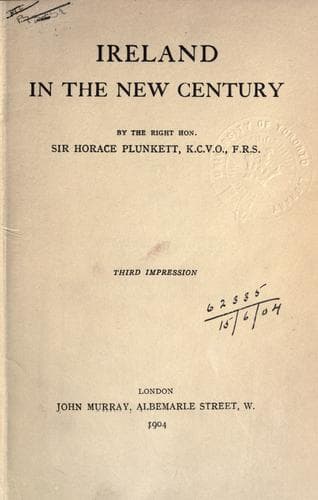
Ireland In The New CenturyPlunkett, Horace Curzon, Sir
History
Ireland In The New Century
Plunkett, Horace Curzon, Sir
Ireland -- Economic conditions; Ireland -- Politics and government -- 1901-1910; Irish question
Those who know Ireland from within are aware that Irish thought upon
Irish problems has been undergoing a silent, and therefore too lightly
regarded revolution. The surface of Irish life, often so inexplicably
ruffled, and sometimes so inexplicably calm, has just now become smooth
to a degree which has led to hasty conclusions as to the real cause and
the inward significance of the change. To chime in with the thoughtless
optimism of the hour will do no good; but a real understanding of the
forces which have created the existing situation will reveal an
unprecedented opportunity for those who would give to the Irish mind
that full and free development which has been so long and, as I have
tried to show, so unnaturally delayed.
Among these new forces in Irish life there is one which has been greatly
misunderstood; and yet to its influence during the last few years much
of the 'transformation scene' in the drama of the Irish Question is
really due. It deserves more than a passing notice here, because, while
its aims as formulated appear somewhat restricted, it unquestionably
tends in practice towards that national object of paramount importance,
the strengthening of character. I refer to the movement known as the
Gaelic Revival. Of this movement I am myself but an outside observer,
having been forced to devote nearly all my time and energies to a
variety of attempts which aim at the doing in the industrial sphere of
very much the same work as that which the Gaelic movement attempts in
the intellectual sphere--the rehabilitation of Ireland from within. But
in the course of my work of agricultural and industrial development I
naturally came across this new intellectual force and found that when it
began to take effect, so far from diverting the minds of the peasantry
from the practical affairs of life, it made them distinctly more
amenable to the teaching of the dry economic doctrine of which I was an
apostle. The reason for this is plain enough to me now, though, like all
my theories about Ireland, the truth came to me from observation and
practical experience rather than as the result of philosophic
speculation. For the co-operative movement depended for its success upon
a two-fold achievement. In order to get it started at all, its
principles and working details had to be grasped by the Irish peasant
mind and commended to his intelligence. Its further development and its
hopes of permanence depend upon the strengthening of character, which, I
must repeat, is the foundation of all Irish progress.
Public-domain text, read in full here on John Shaqi.
Reviews
Reviews
No reviews yet
Be the first to share your thoughts on this work.
Elsewhere in the archive
Join the Discussion
Join the discussion
Sign in to leave a comment or review.
Sign InorCreate an account