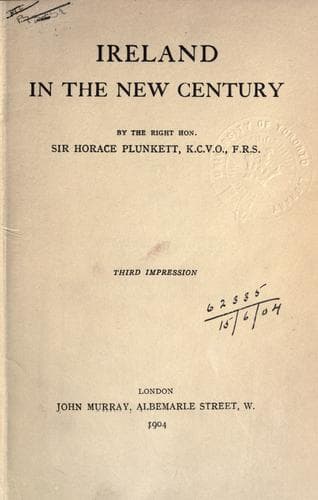
Ireland In The New CenturyPlunkett, Horace Curzon, Sir
History
Ireland In The New Century
Plunkett, Horace Curzon, Sir
Ireland -- Economic conditions; Ireland -- Politics and government -- 1901-1910; Irish question
Thus it is that the elevating influence upon the individual is exerted.
Politics have never awakened initiative among the mass of the people,
because there was no programme of action for the individual. Perhaps it
is as well for Ireland that such should have been the case, for, as it
has been shown, we have had little of the political thought which should
be at the back of political action. Political action under present
conditions must necessarily be deputed to a few representatives, and
after the vote is given or the cheering at a meeting has ceased, the
individual can do nothing but wait, and his lethargy tends to become
still deeper. In the Gaelic revival there is a programme of work for the
individual; his mind is engaged, thought begets energy, and this energy
vitalises every part of his nature. This makes for the strengthening of
character, and so far from any harm being done to the practical
movement, to which I have so often referred, the testimony of my
fellow-workers, as well as my own observation, is unanimous in affirming
that the influence of the branches of the Gaelic League is distinctly
useful whenever it is sought to move the people to industrial or
commercial activity.
Many of my political friends cannot believe--and I am afraid that
nothing that I can say will make them believe--that the movement is not
necessarily, in the political sense, separatist in its sentiment. This
impression is, in my opinion, founded on a complete misunderstanding of
Anglo-Irish history. Those who look askance at the rise of the Gaelic
movement ignore the important fact that there has never been any
essential opposition between the English connection and Irish
nationality. The Elizabethan chiefs of the sixteenth and the Gaelic
poets of the seventeenth and eighteenth centuries, when the relations
between the two countries were far worse than they are to-day, knew
nothing of this opposition. The true sentiment of nationality is a
priceless heritage of every small nation which has done great things,
and had it not largely perished in Ireland, separatist sentiment, the
offspring, not of Irish nationality, but of Irish political nationalism,
could hardly have survived until to-day.
Public-domain text, read in full here on John Shaqi.
Reviews
Reviews
No reviews yet
Be the first to share your thoughts on this work.
Elsewhere in the archive
Join the Discussion
Join the discussion
Sign in to leave a comment or review.
Sign InorCreate an account