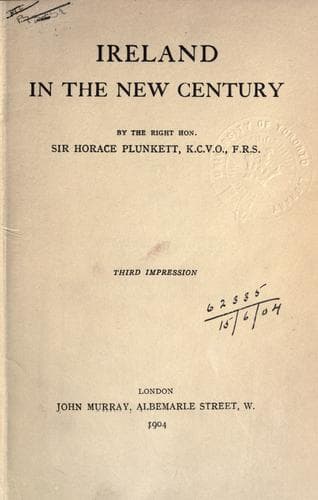
Ireland In The New CenturyPlunkett, Horace Curzon, Sir
History
Ireland In The New Century
Plunkett, Horace Curzon, Sir
Ireland -- Economic conditions; Ireland -- Politics and government -- 1901-1910; Irish question
The question of the Gaelic Revival seems to be really a form of the
eternal question of the interdependence of the practical and the ideal
in Ireland. Their true relation to each other is one of the hardest
lessons the student of our problems has to learn. I recall an incident
in the course of my own studies which I will here recount, as it appears
to me to furnish an admirable illustration of this difficulty as it
presented itself to a very interesting mind. During the years covering
the rise and fall of Parnell, when interest in the Irish Question was at
its zenith, the newspapers of the United States kept in London a corps
of very able correspondents, who watched and reported to their
transatlantic readers every move in the Home Rule campaign. An American
public, by no means limited to the American-Irish, devoured every morsel
of this intelligence with an avidity which could not have been surpassed
if the United States had been engaged in a war with Great Britain. Among
these correspondents perhaps the most brilliant was the late Harold
Frederic. Not many months before he died I received a letter from him,
in which he said that, although we were unknown to each other, he
thought, from some public utterances of mine, that we must have many
views in common. He had often intended to get an introduction to me, and
now suggested that we should 'waive things and meet.' We met and spent
an evening together, which left some deep impressions on my mind. He
told me that the Irish Question possessed for him a fascination for
which he could give no rational explanation. He had absolutely no tie of
blood or material interest with Ireland, and his friendship for it had
brought him the only quarrels in which he had ever been engaged.
What chiefly interested me in Harold Frederic's philosophy of the Irish
Question was that he had arrived at a diagnosis of the Irish mind not
substantially different from my own. Since that evening I have come
across a passage in one of his novels, which clothes in delightful
language his view of the chaotic psychology of the Celt:
There, in Ireland, you get a strange mixture of elementary early
peoples, walled off from the outer world by the four seas, and
free to work out their own racial amalgam on their own lines. They
brought with them at the outset a great inheritance of Eastern
mysticism. Others lost it, but the Irish, all alone on their
island, kept it alive and brooded on it, and rooted their whole
spiritual side in it. Their religion is full of it; their blood is
full of it.... The Ireland of two thousand years ago is incarnated
in her. They are the merriest people and the saddest, the most
turbulent and the most docile, the most talented and the most
unproductive, the most practical and the most visionary, the most
devout and the most pagan. These impossible contradictions war
ceaselessly in their blood.[30]
Public-domain text, read in full here on John Shaqi.
Reviews
Reviews
No reviews yet
Be the first to share your thoughts on this work.
Elsewhere in the archive
Join the Discussion
Join the discussion
Sign in to leave a comment or review.
Sign InorCreate an account