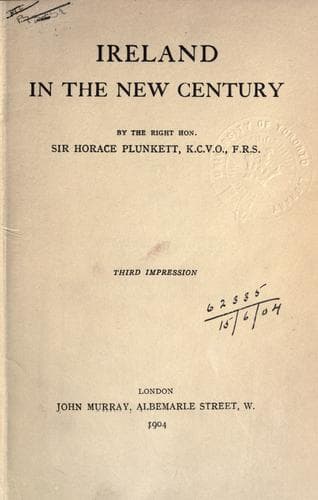
Ireland In The New CenturyPlunkett, Horace Curzon, Sir
History
Ireland In The New Century
Plunkett, Horace Curzon, Sir
Ireland -- Economic conditions; Ireland -- Politics and government -- 1901-1910; Irish question
The practical form which our work took was the launching upon Irish life
of a movement of organised self-help, and the subsequent grafting upon
this movement of a system of State-aid to the agriculture and industries
of the country. I need not here further elaborate this programme, for
the steps by which it has been and is being adopted will be presently
described in detail. But there is one aspect of the new movement in
Ireland which must be understood by those who would grasp the true
significance and the human interest of an evolution in our national
life, the only recent parallel for which, as far as I am aware, is to be
found in Japan: though to my mind the conscious attempt of the Irish
people to develop a civilisation of their own is far more interesting
than the recent efforts of the Japanese to westernise their
institutions.
The problem of mind and character with which we had to deal in Ireland
presented this central and somewhat discouraging fact. In practical life
the Irish had failed where the English had succeeded, and this was
attributed to the lack of certain English qualities which have been
undoubtedly essential to success in commerce and in industry from the
days of the industrial revolution until a comparatively recent date. It
was the individualism of the English economic system during this period
which made these qualities indispensable. The lack of these qualities in
Irishmen to-day may be admitted, and the cause of the deficiency has
been adequately explained. But those who regard the Irish situation as
industrially hopeless probably ignore the fact that there are other
qualities, of great and growing importance under modern economic
conditions, which can be developed in Irishmen and may form the basis of
an industrial system. I refer to the range of qualities which come into
play rather in association than in the individual, and to which the term
'associative' is applied.[34] So that although much disparaging
criticism of Irish character is based upon the survival in the Celt of
the tribal instincts, it is gratifying to be able to show that even from
the practical English point of view, our preference for thinking and
working in groups may not be altogether a _damnosa hereditas_. If, owing
to our deficiency in the individualistic qualities of the English, we
cannot at this stage hope to produce many types of the 'economic man' of
the economists, we think we see our way to provide, as a substitute, the
economic association. If the association succeeds, and by virtue of its
financial success becomes permanent, a great change will, in our
opinion, be produced on the character of its members. The reflex action
upon the individual mind of the habit of doing, in association with
others, things which were formerly left undone, or badly done, may be
relied upon to have a tonic effect upon the character of the individual.
This is, I suppose, the secret of discipline, which, though apparently
Public-domain text, read in full here on John Shaqi.
Reviews
Reviews
No reviews yet
Be the first to share your thoughts on this work.
Elsewhere in the archive
Join the Discussion
Join the discussion
Sign in to leave a comment or review.
Sign InorCreate an account