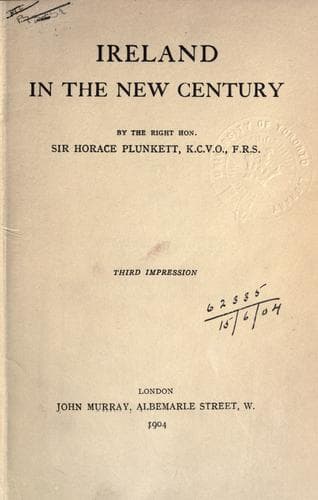
Ireland In The New CenturyPlunkett, Horace Curzon, Sir
History
Ireland In The New Century
Plunkett, Horace Curzon, Sir
Ireland -- Economic conditions; Ireland -- Politics and government -- 1901-1910; Irish question
was reduced, and the proprietor, finding it necessary to give the
suppliers only what they could make out of their milk without his modern
equipment, realised profits altogether out of proportion to his share of
the capital embarked or the labour involved in the production of the
butter.
The economic position was ideal for our purpose, and we had no
difficulty in explaining it to the farmers themselves. The social
problem was the real difficulty. To all suggestions of co-operative
action they at first opposed a hopeless _non possumus_. Their objections
may be summed up thus:--They had never combined for any business
purpose. How could they trust the Committee they were asked to elect
from amongst themselves to expend their money and conduct their
business? It was all very well for the proprietor with his ample
capital, free hand, and business experience, to work with complicated
machinery and to consign his butter out of the reach of the local butter
buyer, and to save the waste and delay of the local butter market. But
they knew nothing of the business and would only make fools of
themselves. The promoters--they were not putting anything into the
scheme--how much did they intend to take out?[38]
There was nothing in this attitude of mind which we had not fully
anticipated. We were confident that, as we were on sound economic
ground, no matter what difficulties might confront us it was only a
question of time for the attainment of our ends. All that was required
was that we should keep pegging away. My own experience was not
encouraging at first. I was, and am, a poor speaker, and in Ireland a
man who cannot express his thoughts with facility, whether he has got
them or not, accentuates the difficulties under which a prophet labours
in his own country. I made up for my deficiencies in the first essential
of Irish public life by engaging a very eloquent political speaker, the
late Mr. Mulhallen Marum, M.P., to stump the country. He gave to the
propaganda a relish which my prosaic economics altogether lacked. The
nationalist band sometimes came out to meet him. We all know the
efficiency of the drum in politics and religion, but it seemed to me a
little out of place in economics. However, he created an excellent
impression, but unhappily he died of heart disease before he had
attended more than three or four meetings. This was a severe blow to us,
and we toiled away under some temporary discouragement. My own diary
records attendance at fifty meetings before a single society had
resulted therefrom. It was weary work for a long time. These gatherings
were miserable affairs compared with those which greeted our political
speakers. On one occasion the agricultural community was represented by
the Dispensary Doctor, the Schoolmaster, and the Sergeant of Police.
Sometimes, in spite of copious advertising of the meeting, the prosaic
nature of the objects had got abroad, and nobody met.
Public-domain text, read in full here on John Shaqi.
Reviews
Reviews
No reviews yet
Be the first to share your thoughts on this work.
Elsewhere in the archive
Join the Discussion
Join the discussion
Sign in to leave a comment or review.
Sign InorCreate an account