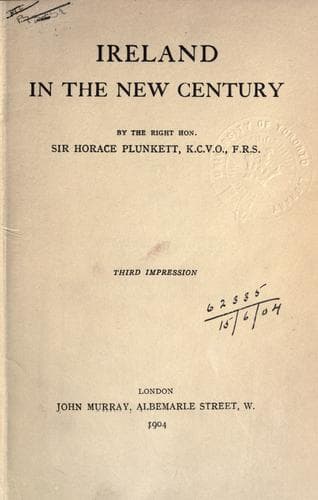
Ireland In The New CenturyPlunkett, Horace Curzon, Sir
History
Ireland In The New Century
Plunkett, Horace Curzon, Sir
Ireland -- Economic conditions; Ireland -- Politics and government -- 1901-1910; Irish question
The very nature of the work which the Department was called into
existence to accomplish made it absolutely essential that it should keep
in touch with the classes whom its work would most immediately affect,
and without whose active co-operation no lasting good could be achieved.
The machinery for this purpose was provided by the establishment of a
Council of Agriculture and two Boards, one of the latter being concerned
with agriculture, rural industries, and inland fisheries, the other with
technical instruction. These representative bodies, whose constitution
is interesting as a new departure in administration, were adapted from
similar continental councils which have been found by experience, in
those foreign countries which are Ireland's economic rivals, to be the
most valuable of all means whereby the administration keeps in touch
with the agricultural and industrial classes, and becomes truly
responsive to their needs and wishes.
The Council of Agriculture consists of two members appointed by each
County Council (Cork being regarded as two counties and returning four
members), making in all sixty-eight persons. The Department also appoint
one half this number of persons, observing in their nomination the same
provincial proportions as obtained in the appointments by the popular
bodies. This adds thirty-four members, and makes in all one hundred and
two Councillors, in addition to the President and Vice-President of the
Department, who are _ex-officio_ members. Thus, if all the members
attended a Council meeting, the Vice-President would find himself
presiding over a body as truly representative of the interests concerned
as could be brought together, consisting, by a strange coincidence, of
exactly the same number as the Irish representatives in Parliament.
The Council, which is appointed for a term of three years, the first
term dating from the 1st April, 1900, has a two-fold function. It is, in
the first place, a deliberative assembly which must be convened by the
Department at least once a year. The domain over which its deliberations
may travel is certainly not restricted, as the Act defines its function
as that of "discussing matters of public interest in connection with any
of the purposes of this Act." The view Mr. Gerald Balfour took was that
nothing but the new spirit he laboured to evoke would make his machine
work. Although he gave the Vice-President statutory powers to make
rules for the proper ordering of the Council debates, I have been well
content to rely upon the usual privileges of a chairman. I have
estimated beforehand the time required for the discussion of matters of
inquiry: the speakers have condensed their speeches accordingly, the
business has been expeditiously transacted, and in the mere exchange of
ideas invaluable assistance has been given to the Department.
Public-domain text, read in full here on John Shaqi.
Reviews
Reviews
No reviews yet
Be the first to share your thoughts on this work.
Elsewhere in the archive
Join the Discussion
Join the discussion
Sign in to leave a comment or review.
Sign InorCreate an account