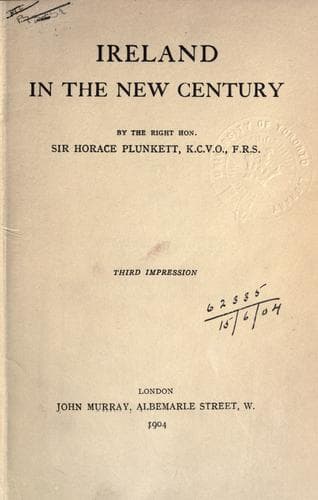
Ireland In The New CenturyPlunkett, Horace Curzon, Sir
History
Ireland In The New Century
Plunkett, Horace Curzon, Sir
Ireland -- Economic conditions; Ireland -- Politics and government -- 1901-1910; Irish question
In the case of agriculture our task is perfectly plain. We know pretty
well what we want to do, for we are dealing with an existing industry,
and with known conditions. The productivity of the soil, the demand of
the market, the means of transport from the one to the other, are all
easily ascertainable. What most needs to be provided in Ireland is a
much higher technical skill, a more advanced scientific and commercial
knowledge, as applied to agricultural production and distribution.[49]
This, in our belief, depends, more than upon any other agency, upon the
soundness of the education which is provided to develop the capacities
of those in charge of these operations. Our chief difficulty is that of
co-ordinating our teaching of technical agriculture with the general
educational systems of the country--a difficulty which the other
educational authorities are all united with us in seeking to remove.
When, on the other hand, education--again, I believe, the chief agency
for the purpose--is considered as a means for the creation of new
industries, we come face to face with a wholly different problem. We
have no longer an industry which we are seeking to foster and develop
going on under our eyes, steadying us in our theorising, and in our
experimenting upon the mind of the worker, by bringing us into close
touch with the actual conditions of his work. Our chief aim must be to
develop his adaptability for the ever-changing and, we hope, improving
economic industrial conditions amidst which he will have to work. But
unless we can satisfy parents that the schemes of development in which
their children are being educated to take their place have an assured
prospect of practical realisation, they will naturally prefer an
inferior teaching which seems to them to offer a better prospect of an
immediate wage or salary. The teachers in the secondary schools of the
country, who, so far, have shown a desire to assist us in giving an
industrial and commercial direction to our educational policy, would
also in that event have to meet the wishes of the parents; and thus
education would fall back into the old rut with its cramming, its
examinations and result fees--all leading to the multiplication of
clerks and professional men, and preventing us from turning the thoughts
and energies of the people towards productive occupations.
Public-domain text, read in full here on John Shaqi.
Reviews
Reviews
No reviews yet
Be the first to share your thoughts on this work.
Elsewhere in the archive
Join the Discussion
Join the discussion
Sign in to leave a comment or review.
Sign InorCreate an account