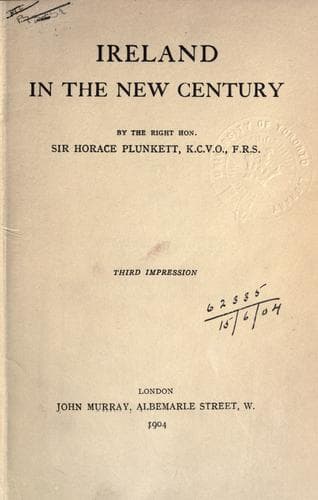
Ireland In The New CenturyPlunkett, Horace Curzon, Sir
History
Ireland In The New Century
Plunkett, Horace Curzon, Sir
Ireland -- Economic conditions; Ireland -- Politics and government -- 1901-1910; Irish question
I think the reader will now understand the general character of the
problem with which we were confronted and the means by which its
solution is being sought. Our policy was not one which was likely to
commend itself to the "man in the street." Indeed, to be quite candid,
it was a little disappointing even to myself that I could not
immortalise my appointment by erecting monuments both to my constructive
ability and to my educational zeal in the shape of stately edifices at
convenient railway centres, preferably along the tourist routes. We have
had to stand the fire of the critic fresh from his holiday on the
Continent where he had seen agricultural and technological institutions,
magnificently housed and lavishly equipped, fitting generations of young
men and young women for competition with our less fortunate countrymen.
It is hard to prevail in argument against the man who has gone and seen
for himself. It is useless to point out to the man with a kodak that the
Corinthian façade and the marble columns of the _aula maxima_ which
aroused his patriotic envy are but a small part of the educational
structure which he saw and thought he understood. If he would read the
history of the systems and trace the successive stages by which the need
for these great institutions was established, he would have a little
more sympathy with the difficulties of the Department, a little more
patience with its Fabian policy.
I must not, however, utter a word which suggests that the Department has
any ground of complaint against the country for the spirit in which it
has been met; especially as there was one factor to be taken into
account which made it difficult for public opinion to approve of our
policy. As I have already explained, a large capital sum of a little
over £200,000 was handed over to the Department at its creation. During
the first year, what with the organisation of the staff, the thinking
out of a policy on every side of the Department's work, the constitution
of the statutory committees to administer its local schemes in town and
country, the agreement, after long discussion, between the central body
and these committees upon the local schemes, and all the other
preparatory steps which had to be taken before money could wisely be
applied, it is obvious that the Department could not have spent its
income. In the second year, and even the third year, savings were
effected, and the original capital sum has been largely increased. What
more natural than that in a poor country a spending Department which was
backward in spending should appear to be lacking in enterprise, if not
in administrative capacity? But whether the policy was right or wrong it
has unquestionably been approved by the best thought in the country, a
fact which throws a very interesting light upon the constitutional
aspects of the Department. At each successive stage the policy was
discussed at the Council of Agriculture and its practical operation was
Public-domain text, read in full here on John Shaqi.
Reviews
Reviews
No reviews yet
Be the first to share your thoughts on this work.
Elsewhere in the archive
Join the Discussion
Join the discussion
Sign in to leave a comment or review.
Sign InorCreate an account