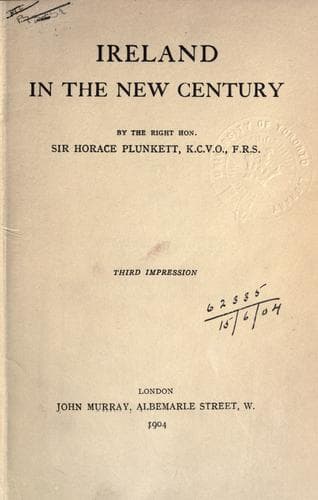
Ireland In The New CenturyPlunkett, Horace Curzon, Sir
History
Ireland In The New Century
Plunkett, Horace Curzon, Sir
Ireland -- Economic conditions; Ireland -- Politics and government -- 1901-1910; Irish question
The political backwardness of the Irish people revealed itself
characteristically when, in 1884, the English and Irish democracies were
simultaneously endowed with a greatly extended franchise. In theory this
concession should have developed political thought in the people and
should have enhanced their sense of political responsibility. In England
no doubt this theory was proved by the event to be based on fact; but in
Ireland it was otherwise. Parnell was at the zenith of his power. The
Irish had the man, what mattered the principles? The new suffrages
simply became the figures upon the cheques handed over to the Chief by
each constituency, with the request that he would fill in the name of
the payee. On one or two occasions a constituency did protest against
the payee, but all that was required to settle the matter was a personal
visit from the Chief. Generally speaking, the electorate were quite
docile, and instances were not wanting of men discovering that they had
found favour with electors to whom their faces and even their names were
previously unknown.
No doubt, the one-man system had a tactical value, of which the English
themselves were ever ready to make use. "If all Ireland cannot rule this
man, then let this man rule all Ireland," said Henry VII. of the Earl of
Kildare; and the echo of these words was heard when the Kilmainham
Treaty was negotiated with the last man who wore the mantle of the
chief. But whatever may be said for the one-man system as a means of
political organisation, it lacked every element of political education.
It left the people weaker, if possible, and less capable than it found
them; and assuredly it was no fit training for Home Rule. While
Parnell's genius was in the ascendant, all was well--outwardly. When a
tragic and painful disclosure brought about a crisis in his fate, it
will hardly be contended by the most devoted admirer of the Irish people
that the situation was met with even moderate ability and foresight. But
the logic of events began to take effect. The decade of dissension which
followed the fall of Parnell will, perhaps, some day be recognised as a
most fruitful epoch in modern Irish history. The reaction from the
one-man system set in as soon as the one man had passed away. The
independence which Parnell's former lieutenants began to assert when the
laurels faded upon the brow of the uncrowned King communicated itself to
some extent to the rank and file. The mere weighing of the merits of
several possible successors led to some wholesome questioning as to the
merits of the policies, such as they were, which they respectively
represented The critical spirit which was now called forth, did not, at
first, go very far; but it was at least constructive and marked a
distinct advance towards real political thought. I believe the day will
come, and come soon, when Nationalist leaders themselves will recognise
that while bemoaning faction and dissension and preaching the cause of
Public-domain text, read in full here on John Shaqi.
Reviews
Reviews
No reviews yet
Be the first to share your thoughts on this work.
Join the Discussion
Join the discussion
Sign in to leave a comment or review.
Sign InorCreate an account