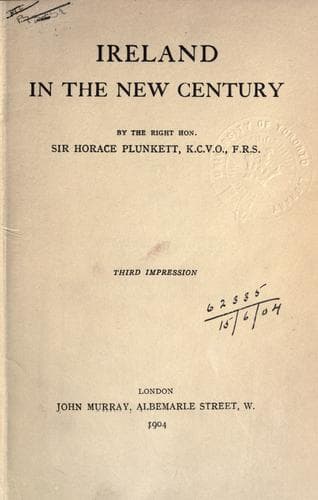
Ireland In The New CenturyPlunkett, Horace Curzon, Sir
History
Ireland In The New Century
Plunkett, Horace Curzon, Sir
Ireland -- Economic conditions; Ireland -- Politics and government -- 1901-1910; Irish question
It was not on purely pedagogic grounds that I added to my other
political irregularities the earnest advocacy of such a provision for
higher education as Roman Catholics will avail themselves of. This great
need was revealed to me in my study of the Irish mind and of the
direction in which it could look for its higher development. My belief
is based on practical experience; my point of view is that of the
economist. When the new economic mission in Ireland began now fourteen
years ago, we had to undertake, in addition to our practical programme,
a kind of University extension work with the important omission of the
University. We had to bring home to adult farmers whose general
education was singularly poor, though their native intelligence was keen
and receptive, a large number of general ideas bearing on the productive
and distributive side of their industry. Our chief obstacles arose from
the lack of trained economic thought among all classes, and especially
among those to whom the majority looked for guidance. The air was thick
with economic fallacies or half-truths. We were, it is true, successful
beyond our expectations in planting in apparently uncongenial soil sound
economic principles. But our success was mainly due, as I shall show
later, to our having used the associative instincts of the Irish peasant
to help out the working of our theories; and we became convinced that if
a tithe of our priests, public men, national school teachers, and
members of our local bodies had received a university education, we
should have made much more rapid progress.
I hardly know how to describe the mental atmosphere in which we were
working. It would be no libel upon the public opinion upon which we
sought to make an impression to say that it really allowed no question
to be discussed on its merits. Public opinion on social and economic
questions is changing now, but I cannot associate the change with any
influence emanating from institutions of higher education. In other
countries, so far as my investigations have extended, the universities
do guide economic thought and have a distinct though wholly unofficial
function as a court of appeal upon questions relating to the material
progress of the communities amongst which they are situated. Of such
institutions there are in Ireland only two which could be expected to
direct in any large way the thought of the country upon economic and
other important national questions--Maynooth, and Trinity College,
Dublin. Whether in their widely different spheres of influence these two
institutions could, under conditions other than those prevailing, have
so met the requirements of the country as to have obviated what is at
present an urgent necessity for a complete reorganisation of higher
education need not be discussed; but it is essential to my argument that
I should set forth clearly the results of my own observation upon their
influence, or rather lack of influence, upon the people among whom I
have worked.
Public-domain text, read in full here on John Shaqi.
Reviews
Reviews
No reviews yet
Be the first to share your thoughts on this work.
Elsewhere in the archive
Join the Discussion
Join the discussion
Sign in to leave a comment or review.
Sign InorCreate an account