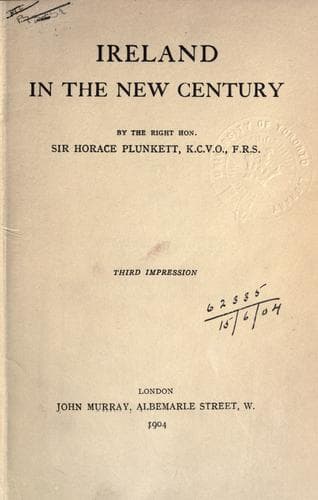
Ireland In The New CenturyPlunkett, Horace Curzon, Sir
History
Ireland In The New Century
Plunkett, Horace Curzon, Sir
Ireland -- Economic conditions; Ireland -- Politics and government -- 1901-1910; Irish question
It is, therefore, to Trinity College, or the University of Dublin, that
one would naturally turn as to a great centre of thought in Ireland for
help in the theoretic aspects, at least, of the practical problems upon
whose successful solution our national well-being depends. Judged by
the not unimportant test of the men it has supplied to the service of
the State and country during its three centuries of educational
activity, by the part it took in one of the brightest epochs of these
three centuries--the days when it gave Grattan to Grattan's Parliament,
by the work and reputation of the _alumni_ it could muster to-day within
and without its walls, our venerable seat of learning need not fear
comparison with any similar institutions in Great Britain. It may also,
of course, be said that many men who have passed through Trinity College
have impressed the thought of Ireland, and, indeed, of the world, in one
way or another--such men as, to take two very different examples, Burke
and Thomas Davis--but on some of the very best spirits amongst these men
Trinity College and its atmosphere have exerted influence rather by
repulsion than by attraction; and certainly their characteristics of
temper or thought have not been of a kind which those best acquainted
with the atmosphere of Trinity College associate with that institution.
Still nothing can detract from the credit of having educated such men.
But these tests and standards are, for my present purpose, irrelevant. I
am not writing a book on Irish educational history, or even a record of
present-day Irish educational achievement. I am rather trying, from the
standpoint of a practical worker for national progress, to measure the
reality and strength of the educational and other influences which are
actually and actively operating on the character and intellect of the
majority of the Irish people, moulding their thought and directing
their action towards the upbuilding of our national life.
From this point of view I am bound to say that Trinity College, so far
as I have seen, has had but little influence upon the minds or the lives
of the people. Nor can I find that at any period of the extraordinarily
interesting economic and social revolution, which has been in progress
in Ireland since the great catastrophe of the Famine period, Dublin
University has departed from its academic isolation and its aloofness
from the great national problems that were being worked out. The more
one thinks of it, indeed, and the more one realises the opportunities of
an institution like Trinity College in a country like Ireland, the more
one must recognise how small, in recent times, has been its positive
influence on the mind of the country, and how little it has contributed
towards the solution of any of those problems, educational, economic, or
social, that were clamant for solution, and which in any other country
would have naturally secured the attention of men who ought to have been
leaders of thought.
Public-domain text, read in full here on John Shaqi.
Reviews
Reviews
No reviews yet
Be the first to share your thoughts on this work.
Elsewhere in the archive
Join the Discussion
Join the discussion
Sign in to leave a comment or review.
Sign InorCreate an account