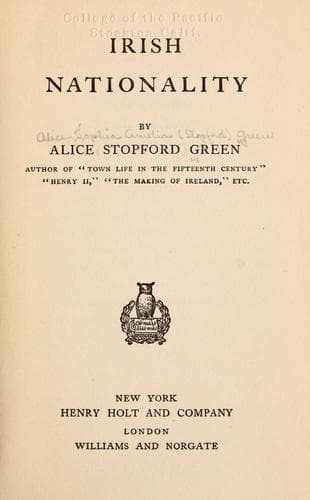
Ireland -- History; Ireland -- Politics and government; Irish question
Oppressive financial burdens were laid on the Irish. Each country was
for the next twenty years to provide for its own expenditure and debt,
and to contribute a sum to the general expenses of the United Kingdom,
fixed in the proportion of seven and a half parts for Great Britain
and one part for Ireland. The debt of Ireland had formerly been small;
in 1793 it was 2-¼ millions; it had risen to nearly 28 millions by
1801, in great measure through the charges of Clare's policy of
martial law and bribery. In the next years heavy loans were required
for the Napoleonic war. When Ireland, exhausted by calamity, was
unable to pay, loans were raised in England at heavy war-rates and
charged to the public debt of Ireland. In 1817 the Irish debt had
increased more than fourfold, to nearly 113 millions. No record was
made in the books of the Exchequer as to what portion of the vast sums
raised should in fairness be allotted to Ireland; there is no proof
that there was any accuracy in the apportionment. The promised lighter
taxation ended in a near bankruptcy, and the approach of an appalling
famine in 1817. Bankruptcy was avoided by uniting the two treasuries
to form one national debt--but the burden of Ireland remained as
oppressive as before. Meanwhile the effect of the Union had been to
depress all Irish industries and resources, and in these sixteen years
the comparative wealth of Ireland had fallen, and the taxes had risen
far beyond the rise in England. The people sank yet deeper under their
heavy load. The result of their incapacity to pay the amount fixed at
the Union was, that of all the taxes collected from them for the next
fifty-three years, one-third was spent in Ireland, and two-thirds were
absorbed by England; from 1817 to 1870 the cost of government in
Ireland was under 100 millions, while the contributions to the
imperial exchequer were 210 millions, so that Ireland sent to England
more than twice as much as was spent on her. The tribute from Ireland
to England in the last ninety-three years, over and above the cost of
Irish administration, has been over 325 millions--a sum which would
probably be much increased by a more exact method both of recording
the revenue collected from Ireland and the "local" and "imperial"
charges, so as to give the full Irish revenue, and to prevent the
debiting to Ireland of charges for which she was not really liable.
While this heavy ransom was exacted Ireland was represented as a
beggar, never satisfied, at the gates of England.
Public-domain text, read in full here on John Shaqi.
Reviews
Reviews
No reviews yet
Be the first to share your thoughts on this work.
Elsewhere in the archive
Join the Discussion
Join the discussion
Sign in to leave a comment or review.
Sign InorCreate an account