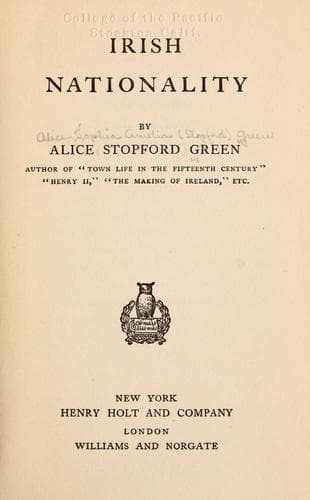
Ireland -- History; Ireland -- Politics and government; Irish question
All the dangers of the Union were increased by its effect in drawing
Irish landlords to London. Their rents followed them, and the wealth
spent by absentees founded no industries at home. A land system
brought about by confiscation, and developed by absentees, meant
unreclaimed wastes, lands half cultivated, and neglected people.
Landlords, said an indignant judge of wide experience in a charge to a
jury in 1814, should build their tenants houses, and give them at
least what they had not as yet, "the comforts of an English sow." To
pay rent and taxes in England the toilers raised stores of corn and
cattle for export there, from the value of eight million pounds in
1826 to seventeen million pounds of food stuffs in 1848, and so on.
They grew potatoes to feed themselves. If the price of corn fell
prodigiously--as at the end of the Napoleonic war, or at the passing
of the corn laws in England--the cheaper bread was no help to the
peasants, most of whom could never afford to eat it; it only doubled
their labour to send out greater shiploads of provisions for the
charges due in England. On the other hand, if potatoes rotted, famine
swept over the country among its fields of corn and cattle. And when
rent failed, summary powers of eviction were given at Westminster
under English theories for use in Ireland alone; "and if anyone would
defend his farm it is here denominated rebellion." Families were flung
on the bogs and mountain sides to live on wild turnips and nettles, to
gather chickweed, sorrel, and seaweed, and to sink under the fevers
that followed vagrancy, starvation, cold, and above all the broken
hearts of men hunted from their homes. In famine time the people to
save themselves from death were occasionally compelled to use blood
taken from live bullocks, boiled up with a little oatmeal; and the
appalling sight was seen of feeble women gliding across the country
with their pitchers, actually trampling upon fertility and fatness, to
collect in the corner of a grazier's farm for their little portion of
blood. Five times between 1822 and 1837 there were famines of lesser
degree: but two others, 1817 and 1847, were noted as among the
half-dozen most terrible recorded in Europe and Asia during the
century. From 1846 to 1848 over a million lay dead of hunger, while in
a year food-stuffs for seventeen million pounds were sent to England.
English soldiers guarded from the starving the fields of corn and the
waggons that carried it to the ports; herds of cattle were shipped,
and skins of asses which had served the famishing for food. New
evictions on an enormous scale followed the famine, the clearance of
what was then called in the phrase of current English economics "the
surplus population," "the overstock tenantry." They died, or fled in
hosts to America--Ireland pouring out on the one side her great stores
or "surplus food," on the other her "surplus people," for whom there
was nothing to eat. In the twenty years that followed the men and
Public-domain text, read in full here on John Shaqi.
Reviews
Reviews
No reviews yet
Be the first to share your thoughts on this work.
Elsewhere in the archive
Join the Discussion
Join the discussion
Sign in to leave a comment or review.
Sign InorCreate an account