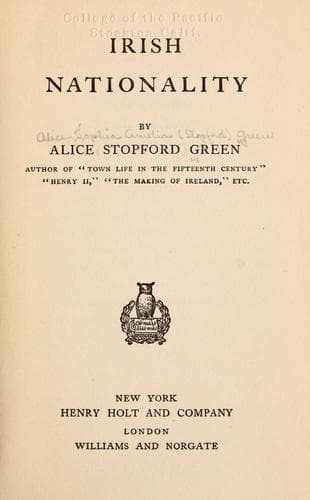
Ireland -- History; Ireland -- Politics and government; Irish question
Unknown scribes still copied piously the national records. A Louth
schoolmaster could tell all the stars and constellations of heaven
under the old Irish forms and names. A vision is given to us through a
government Ordnance Survey of the fire of zeal, the hunger of
knowledge, among the tillers and the tenants. In 1817 a dying farmer
in Kilkenny repeated several times to his sons his descent back to the
wars of 1641 and behind that to a king of Munster in 210
A.D.--directing the eldest never to forget it. This son took his
brother, John O'Donovan, (1809-1861) to study in Dublin; in Kilkenny
farmhouses he learned the old language and history of his race. At the
same time another Irish boy, Eugene O'Curry (1796-1862), of the same
old Munster stock, working on his father's farm in great poverty,
learned from him much knowledge of Irish literature and music. The
Ordnance Survey, the first peripatetic university Ireland had seen
since the wanderings of her ancient scholars, gave to O'Donovan and
O'Curry their opportunity, where they could meet learned men, and use
their hereditary knowledge. A mass of material was laid up by their
help. Passionate interest was shown by the people in the memorials of
their ancient life--giants' rings, cairns, and mighty graves, the
twenty-nine thousand mounds or moats that have been counted, the raths
of their saints and scholars--each with its story living on the lips
of the people till the great famine and the death or emigration of the
people broke that long tradition of the race. The cry arose that the
survey was pandering to the national spirit. It was suddenly closed
(1837), the men dismissed, no materials published, the documents
locked up in government offices. But for O'Donovan and O'Curry what
prodigies of work remained. Once more the death of hope seemed to call
out the pieties of the Irish scholar for his race, the fury of his
intellectual zeal, the passion of his inheritance of learning. In the
blackest days perhaps of all Irish history O'Donovan took up Michael
O'Clery's work of two hundred years before, the Annals of the Four
Masters, added to his manuscript the mass of his own learning, and
gave to his people this priceless record of their country (1856).
Among a number of works that cannot be counted here, he made a
Dictionary which recalls the old pride of Irishmen in their language.
O'Curry brought from his humble training an incredible industry,
great stores of ancient lore, and an amazing and delicate skill as a
scribe. All modern historians have dug in the mine of these men's
work. They open to Anglo-Irish scholars such as Dr. Reeves and Dr.
Todd, a new world of Irish history. Sir Samuel Ferguson began in 1833
to give to readers of English the stories of Ireland. George Petrie
collected Irish music through all the west, over a thousand airs, and
worked at Irish inscriptions and crosses and round towers. Lord
Dunraven studied architecture, and is said to have visited every
Public-domain text, read in full here on John Shaqi.
Reviews
Reviews
No reviews yet
Be the first to share your thoughts on this work.
Elsewhere in the archive
Join the Discussion
Join the discussion
Sign in to leave a comment or review.
Sign InorCreate an account